How To Configure API Gateway in Microservices Architecture
Considering the importance of API gateway, understand how they work and what they can do for you.
Software Development Practices
How To Configure API Gateway in Microservices Architecture
Considering the importance of API gateway, understand how they work and what they can do for you.
Table of contents
Table of contents
Key Takeaways
Introduction
What is an API Gateway?
How Does an API Gateway Work?
Top API Gateway Tools in 2026
Why Do You Need an API Gateway in Microservices Architecture?
How to Implement an API Gateway in Microservices?
Microservices API Gateway vs. Traditional API Gateway
How Does an API Gateway Work in Microservices Architecture?
Backend for Frontend (BFF) Pattern
Challenges and Best Practices for API Gateway Implementation
Benefits of API Gateway for Microservices
API Gateway Configuration Considerations
Top Challenges & Trade-Offs with API Gateways in Microservices
API Gateway Security: Identity and Access Control
Conclusion
Why Maruti Techlabs for API Gateway Implementation
FAQs
Key Takeaways
An API Gateway acts as a single entry point, simplifying how clients interact with multiple microservices.
It improves performance and user experience by routing requests, combining responses, and reducing client-side complexity.
API Gateways strengthen security through authentication, validation, threat protection, and controlled access.
Proper configuration, patterns like BFF, and policy management are key to making API Gateways effective.
While useful, API Gateways can add complexity, latency, and operational challenges if not designed carefully.
Introduction
The demand for microservices is increasing as businesses build scalable and flexible applications. However, a key challenge is managing how clients interact with multiple microservices.
This is where microservices architecture differs from monolithic applications. While monolithic systems rely on a single set of endpoints, microservices use multiple fine-grained endpoints to handle specific functions.
Microservices enable teams to work with smaller, independent codebases, making development, deployment, and scaling more efficient.
To simplify communication and improve performance, an API gateway plays a critical role in microservices architecture. It centralizes client interactions, reduces complexity, minimizes errors, and enhances overall application efficiency.
This blog walks you through what an API gateway is, why it is needed, how it works, and the key benefits it brings to a microservices architecture. It also covers practical use cases and explains how it simplifies service communication while improving performance and control.
What is an API Gateway?
An API (Application Programming Interface) is a set of rules that enables communication between different software applications.
An API Gateway acts as a reverse proxy that handles all client requests and routes them to the appropriate microservices. It serves as a single entry point, simplifying how clients interact with a distributed system.
The API gateway manages key functions such as request routing, authentication, load balancing, monitoring, protocol translation, and response aggregation. By centralizing these tasks, it reduces complexity, improves performance, and ensures secure communication between clients and microservices.
There are a total of two different methods by which the API gateway handles the request made by the client:
It routes the client's request to a suitable service.
It spreads clients' requests across multiple services.
A well-known example of an API gateway is the Netflix API gateway. It enables seamless access to Netflix services across multiple devices, including laptops, tablets, smartphones, and televisions.
The API gateway customizes and delivers appropriate responses based on the device type, ensuring optimized performance and a consistent user experience across platforms.
API Gateway vs Load Balancer vs Reverse Proxy
API gateways, load balancers, and reverse proxies all handle incoming traffic, but they serve different purposes.
Load Balancer: It distributes incoming traffic across multiple servers. Its main goal is to prevent any single server from getting overloaded and to keep the application running smoothly.
Reverse Proxy: It sits between users and backend servers, forwarding client requests to the appropriate server and hiding the internal system structure. It can also handle caching, SSL termination, and basic security filtering.
API Gateway: It goes a step further, acting as a single entry point for all API requests in a microservices setup. In addition to routing, it manages authentication, rate limiting, monitoring, request transformation, and sometimes combines responses from multiple services.
In simple terms, a load balancer manages traffic, a reverse proxy protects and forwards requests, and an API gateway manages and controls APIs.
Key Differences at a Glance
Feature
API Gateway
Load Balancer
Reverse Proxy
Primary Role
API management
Traffic distribution
Request forwarding
Authentication Support
Yes
No
Limited
Rate Limiting
Yes
No
Limited
Traffic Distribution
Yes
Yes
No
Hides Backend Services
Yes
No
Yes
Best Use Case
Microservices and APIs
High availability
Security and routing
How Does an API Gateway Work?
An API gateway functions as a central layer that processes all client requests before they reach backend services. It controls how requests are handled, secured, and routed, ensuring smooth communication and a consistent response.
How the Process Flows
Receiving the Request: A client sends a request to a single gateway endpoint instead of calling multiple services directly.
Checking Access: The gateway verifies the request and confirms user identity. Any invalid or unauthorized requests are blocked at this stage.
Controlling Traffic: It manages incoming traffic using limits and rules to prevent overload or misuse.
Sending to the Right Service: The gateway determines which backend service should handle the request and forwards it. It can also adjust the request format if needed.
Combining Results: If multiple services are involved, the gateway collects their responses and merges them into one.
Returning the Response: A single, processed response is sent back to the client.
Tracking Activity: The gateway monitors requests, performance, and errors to support analysis and improvements.
This approach keeps backend services simpler while improving overall efficiency, security, and scalability.
Top API Gateway Tools in 2026
The leading API gateway tools include Kong, AWS API Gateway, Apigee, Azure API Management, and Tyk. Each fits different needs based on your tech stack and scale.
Comparison of API Gateway Tools
Tool
Strength
Best For
Kong Gateway
Flexible, plugin-rich
Microservices, cloud-native apps
AWS API Gateway
Strong AWS integration
AWS-based and serverless apps
Apigee (Google Cloud)
Advanced analytics, governance
Large enterprises
Azure API Management
Smooth Azure integration
Microsoft ecosystem users
Tyk
Open-source + Kubernetes support
Teams wanting flexibility
How to Choose the Right API Gateway
Selecting the right API gateway involves assessing your technical and business requirements against factors such as features, architecture, and cost. There is no single solution that fits every use case.
Deployment type
Choose based on your setup. If your apps run on AWS or Azure, their native gateways are easier to manage. For on-premise or hybrid systems, tools like Kong or Tyk offer more control.
Traffic & performance
If your application handles high traffic or needs low latency, go for lightweight and high-performance gateways like NGINX or APISIX.
Integration complexity
If you work with multiple services, legacy systems, or third-party tools, choose a gateway that supports strong integrations and connectors.
Features required
Look for built-in support for authentication, rate limiting, logging, monitoring, and protocol support (REST, GraphQL, etc.), based on your use case.
Cost vs effort
Open-source tools give flexibility but need in-house expertise to manage. Managed solutions are easier to use but come with higher costs.
Why Do You Need an API Gateway in Microservices Architecture?
An API gateway acts as a single entry point for all client requests. It simplifies how systems work, improves security, and reduces the load on individual services.
Key Benefits of Using an API Gateway
Simplifies client access: Clients interact with a single endpoint instead of calling multiple microservices, making integration easier and reducing client-side complexity.
Improves performance: The gateway combines multiple service calls into one response, reducing network trips and improving response time.
Enhances security: Authentication and authorization are handled in one place, ensuring consistent and secure access across all services.
Reduces duplicate work: Common tasks like rate limiting, logging, and monitoring are managed centrally, so individual services don’t need to handle them.
Balances and routes traffic: Requests are directed to the right service and distributed efficiently, helping maintain availability and performance.
Hides internal complexity: The internal structure of microservices is hidden from clients, allowing teams to update or scale services without affecting users.
How to Implement an API Gateway in Microservices?
Implementing an API gateway requires a structured approach that covers tool selection, API design, security, and ongoing monitoring. Following the right steps helps ensure the gateway integrates smoothly with your microservices architecture and performs reliably.
1. Choose the Right API Gateway
Select a solution based on your budget, infrastructure, and feature requirements. For example, cloud-native teams may prefer AWS or Azure API Gateway, while Kong or Spring Cloud Gateway works well for more flexible or on-premise setups.
2. Design your API
Define your API endpoints, request and response formats, and overall structure. Ensure the design is simple, consistent, and aligned with how clients will consume your services.
3. Integrate with Service Discovery
Connect the API gateway with service discovery tools like Eureka or Consul. This allows the gateway to dynamically locate available microservices and route requests accurately.
4. Executing Primary Functionalities
An API gateway offers numerous features that facilitate your overall API experience. Here is a list of basic functionalities to configure:
Routing: Based on pre-defined rules such as path, method, and headers, the gateway directs incoming requests to the exact microservice.
Security: Manage access to your APIs using an existing authentication or JWT tokens.
Rate Limiting: To prevent misuse, limit the number of requests a client can make within a specific timeframe.
Monitoring and Logging: Learn issues and optimize resources by observing API metrics such as usage and performance.
5. Implement Security Best Practices
Secure your gateway by enabling encryption (HTTPS), applying proper access controls, and keeping systems updated. This helps protect APIs from unauthorized access and common threats.
6. Test Thoroughly Before Deployment
Perform end-to-end testing to validate routing, performance, error handling, and security. Testing across different scenarios ensures the gateway works reliably in real-world conditions.
7. Monitor and Optimize Continuously
After deployment, monitor API performance, traffic patterns, and security events. Use these insights to optimize configurations and improve your microservices architecture over time.
Microservices API Gateway vs. Traditional API Gateway
A microservices API gateway is designed to support distributed systems where multiple services run independently. It allows teams to publish, update, and scale microservices without affecting the entire system. It also handles service-level routing, aggregation, and dynamic scaling.
A traditional API gateway, on the other hand, is typically used in more centralized or monolithic environments. It focuses on exposing a fixed set of APIs, managing access, and enforcing policies like security and rate limiting across fewer, tightly coupled services.
As systems evolved from monolithic to microservices architectures, the need to manage multiple services and endpoints increased. This led to the adoption of API gateways as a central entry point, making it easier to expose, manage, and scale APIs efficiently.
The table below provides a clearer representation of the difference between Microservices API Gateways and Traditional API Gateways.
Traditional API Gateway
Microservices API Gateway
It comes up with a simple mechanism to create new services.
It makes use of tools quickly that allow service teams to easily and safely create new services.
It enables functionality for monitoring the usage of the API per client.
It monitors the user-visible metrics like availability to clients.
Routing manages to change API versions.
It integrates routing to roll out the new versions of services quickly.
Traditional API gateways address the challenges API management faces, but they fail to address the difficulties posed by microservices. Hence, the microservice API gateway integrated into your application allows service teams to monitor, update, and publish services safely and quickly, enabling your organization to develop software more efficiently and effectively than ever before.
How Does an API Gateway Work in Microservices Architecture?
An API gateway acts as a central access layer in a microservices architecture, handling client requests and coordinating communication with multiple backend services. It ensures a secure, consistent, and efficient experience.
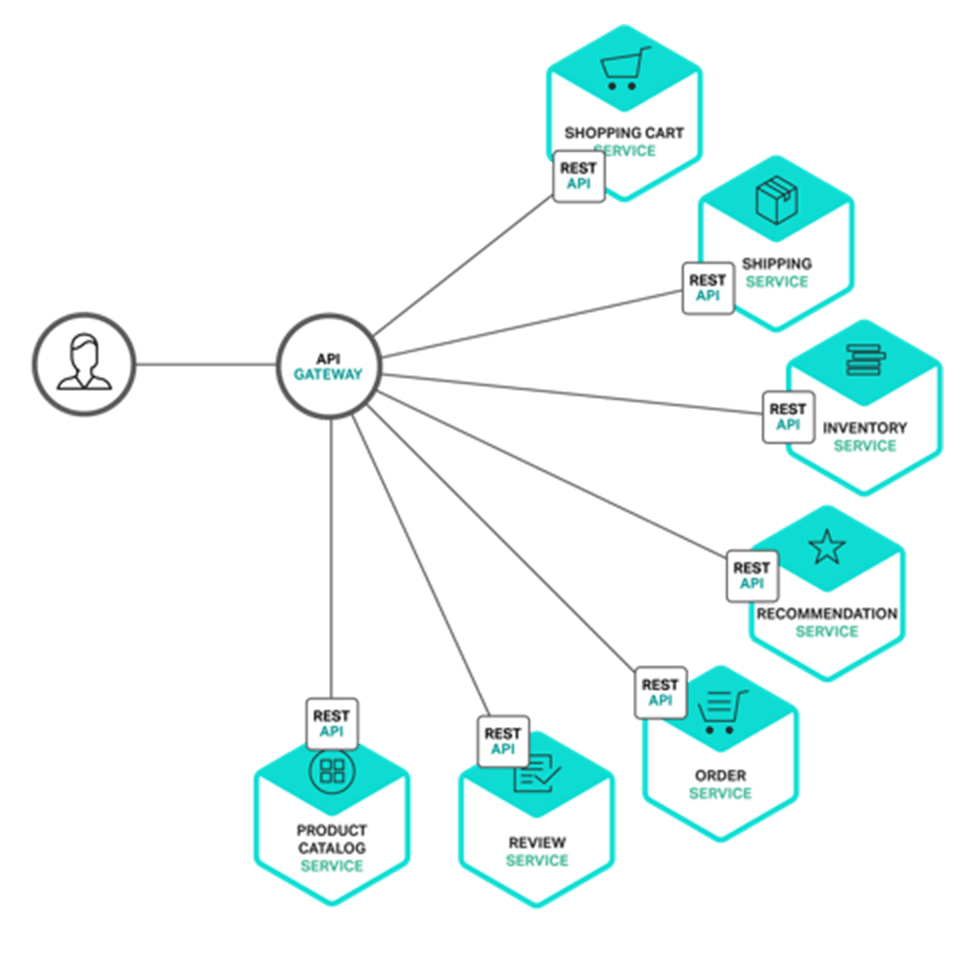
In a monolithic architecture, all data is typically retrieved through a single API call. In contrast, a microservices architecture may require data from multiple services such as order, cart, review, and shipping, each exposing its own endpoint.
If the client directly interacts with these services, it must send multiple requests. This increases complexity and can lead to issues such as API inconsistencies, protocol differences, and higher network traffic.
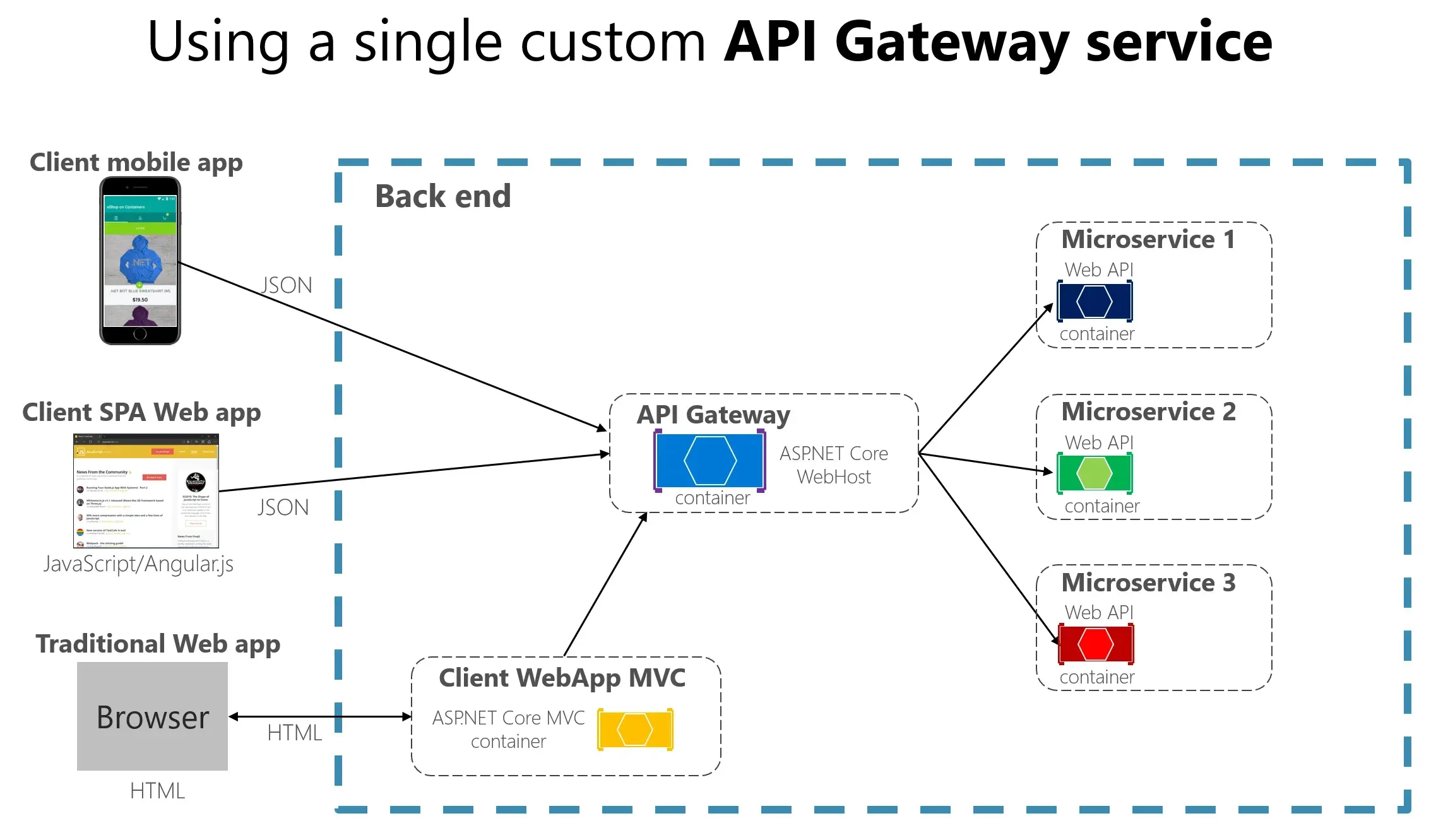
An API gateway simplifies this process by acting as a single entry point. The client sends one request to the gateway, which routes it to the relevant services and combines the responses.
The diagram below illustrates how the API gateway manages client requests and communicates with multiple microservices within the architecture.
The API gateway is responsible for routing, authentication, rate limiting, monitoring, security policies, alerts, and sometimes billing. It intercepts incoming requests, applies necessary rules, and forwards them to the correct services.
Since microservices may run across different locations, the gateway also handles service discovery and inter-service communication.
One important challenge in microservices is partial failure, in which a service may respond slowly or fail. The API gateway can manage such scenarios using timeouts and fallback mechanisms to maintain system stability.
API Composition in Microservices Architecture
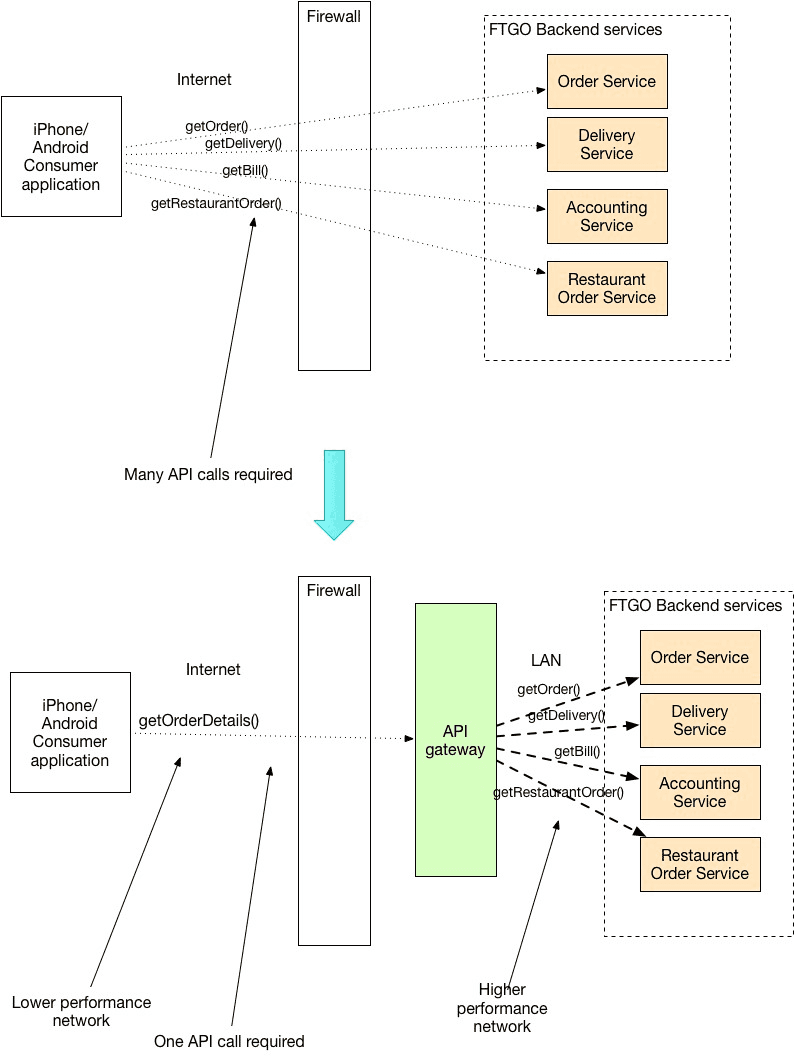
In many cases, one page needs data from multiple services. Instead of the client calling each service separately, the API gateway uses API composition.
The client sends a single request to the gateway. The gateway then calls the required services in parallel, collects their responses, combines the data, and returns a single complete response.
The figure below illustrates how API composition works. For example, in an eCommerce application, fetching order details such as billing, delivery status, and product information may involve order, cart, review, and shipping services. Without an API gateway, the client would need to make multiple API calls to different services.
However, when using an API gateway, the client needs to make only one API call. The gateway then makes multiple service calls in parallel behind the scenes, gathers the required data, and combines it into a single response.
This allows the mobile client to retrieve all the necessary information in a single request.
As a result, the system becomes less complex, performance improves, and the overall architecture is easier to manage and scale.
Backend for Frontend (BFF) Pattern
In the backend-for-the-frontend pattern, a dedicated backend service acts as the endpoint for frontend requests in a microservices architecture.
As applications evolve, microservices often return data that does not fully match the frontend’s format or filtering needs. This increases complexity on the frontend, which then has to handle additional processing.
The BFF pattern introduces an intermediate layer that interacts with relevant microservices, retrieves the required data, and transforms it into a frontend-ready format. This helps simplify frontend logic and improves consistency across applications.
Key Aspects of the BFF Pattern
Tailored for clients: Each frontend (web, iOS, Android) has its own backend aligned with its specific UI needs
Data aggregation: Combines responses from multiple microservices into a single, optimized output
Reduced complexity: Minimizes data processing on the frontend, improving performance on devices
Security and optimization: Handles authentication and delivers optimized payloads based on client requirements
By centralizing data handling and customization, the BFF pattern enables a more efficient and seamless user experience.
Challenges and Best Practices for API Gateway Implementation
Implementing an API gateway involves addressing potential issues related to performance, scalability, service communication, and system reliability. These factors play a critical role in ensuring the gateway functions efficiently within a microservices architecture.
1. Scalability and Performance
High traffic and multiple service calls can slow down response time and affect overall system performance.
Best Practices: Use asynchronous and non-blocking frameworks such as Netty, Undertow, or Node.js to handle concurrent requests efficiently and maintain low latency.
2. Request Handling and Aggregation
A single client request often requires data from multiple services, increasing complexity and latency.
Best Practices: Enable parallel processing and aggregate responses at the gateway level to reduce the number of network calls and improve response time.
3. Service Communication
Microservices may use different communication protocols, making integration difficult.
Best Practices: Support both synchronous (HTTP) and asynchronous messaging (JMS, AMQP), along with brokerless options like ZeroMQ, to ensure flexible and reliable communication.
4. Service Discovery
Dynamic scaling makes it difficult to track the location of service instances.
Best Practices: Integrate the API gateway with service discovery tools to automatically identify and route requests to available services.
5. Handling Failures
Service failures or slow responses can disrupt the overall system and impact user experience.
Best Practices: Use fallback responses and cached data (e.g., viaMemcached) to maintain continuity, and apply circuit breaker patterns using tools likeNetflix Hystrixto prevent cascading failures.
6. Caching and Resilience
Frequent service calls increase system load and reduce reliability during failures.
Best Practices: Use caching for frequently accessed data and apply resilience patterns like circuit breakers to prevent cascading failures.
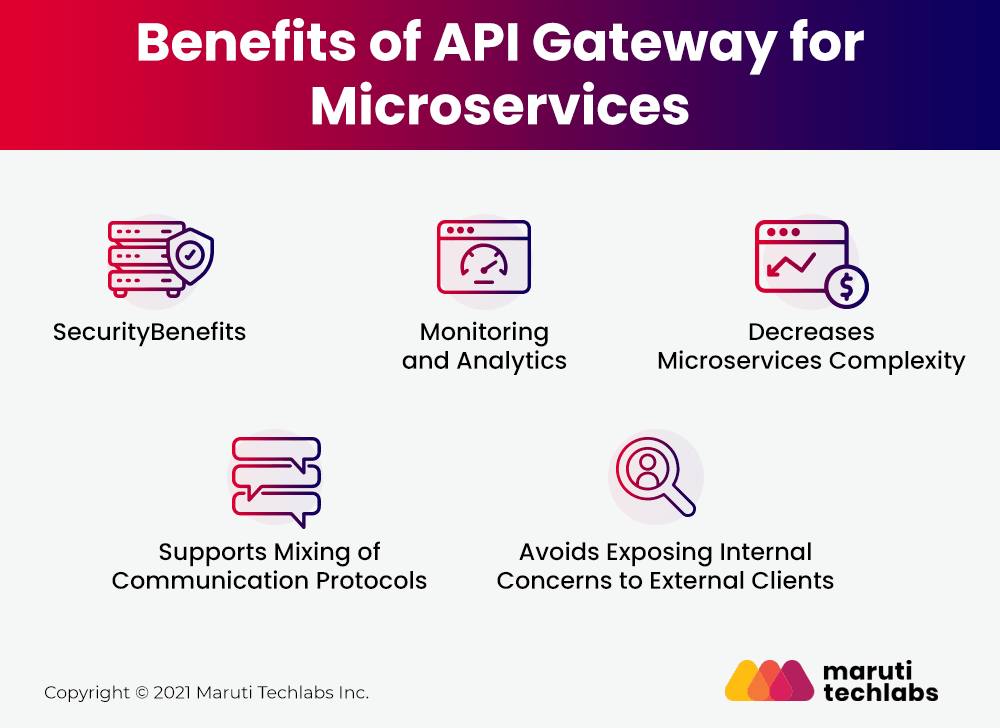
Benefits of API Gateway for Microservices
API Gateway helps the microservices to communicate among themselves internally by providing flexibility and completely independent protocols. It allows the developers to create the architecture subset in various forms without publicly exposing the endpoints. The API gateway offers the following benefits.
1. Security Benefits
API gateway acts as a security layer between the front end and the backend microservices to ensure that the sensitive API endpoints are not exposed publicly. It helps protect the API from malicious attacks, such as SQL injection and other threats that may exploit its vulnerabilities.
The API client can integrate data information with session information, like Redis, specifically created for trusted clients. Therefore, without the API gateway, Redis would directly expose the client, increasing security risks.
2. Monitoring and Analytics
Some API gateways help developers debug and create infrastructure that can gracefully scale. The best example is Dashbird.io, which integrates with the AWS API gateway and collects metrics such as execution time, errors, and more. Not all API gateways provide this service, so some third-party monitoring solutions infer the scenario behind the scenes.
3. Decreases Microservices Complexity
API gateway in a microservice helps reduce its complexity by managing the user access control, authentication issues, and rate limiting, and allows your API to focus on the primary goal.
This creates an effective advantage as your API doesn’t have to respond in any possible way. API gateway handles your routing, formats of the responses, and even the cache of the system.
4. Support for Mixing Communication Protocols
Internal microservices benefit from using different communication protocols by using API gateway. An API gateway can provide a unified REST-based API across various protocols, allowing applications to choose the best internal architecture.
5. Avoids Exposing Internal Concerns to External Clients
An API gateway helps separate external APIs from internal microservice patterns. It hides the service history and versioning details from the clients for all your microservices. As output, you gain the ability to refactor the microservice over time, removing all negative impacts of externally bound clients.
Apart from these benefits, the microservices API gateway allows clients to make a single data request. It helps clients access several microservices and get enough information on a single screen.
Each of these request calls uses network bandwidth and client code. This single call returns the result far more efficiently than several calls at the same time. A microservices API gateway automatically performs protocol translations so everyone can speak the same language, enabling faster data flow between endpoints.
Summarizing the benefits of the API gateway:
It enables the clients to partition the applications into microservices.
It enables the clients to determine the location of service problems.
It creates the optimal API for a particular client individually.
API gateway reduces the number of request/response calls. It takes a single request call from the client to fetch multiple services at the same time with a single round trip.
It converts the standard public web-friendly protocol into the internal protocol.
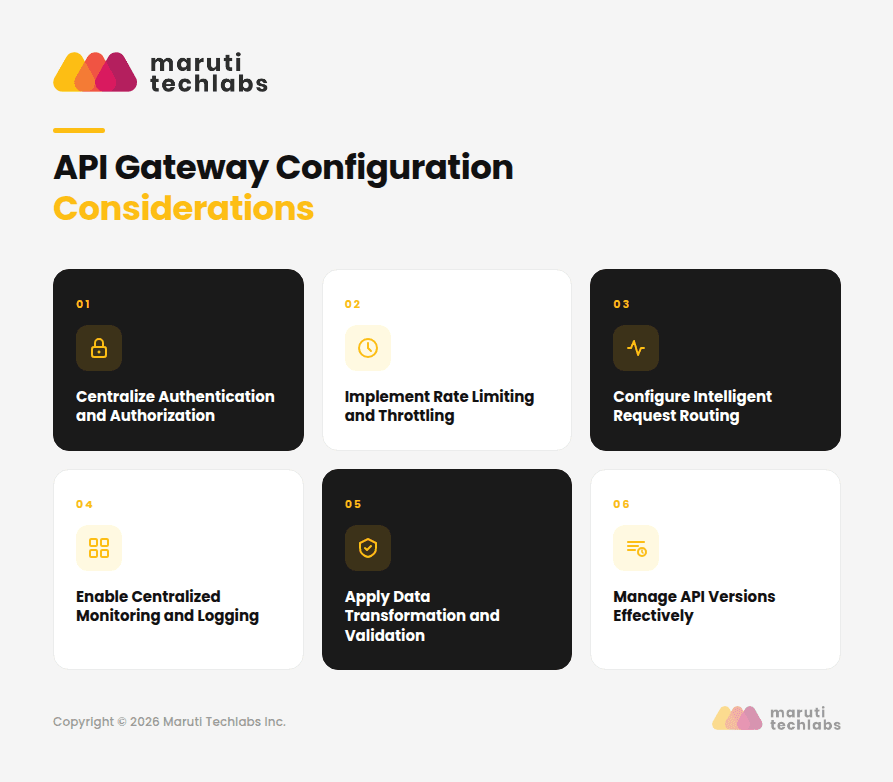
API Gateway Configuration Considerations
Configuring an API gateway requires careful attention to access control, traffic management, and system visibility. The following considerations help ensure smooth service communication and better operational control.
1. Centralize Authentication and Authorization
Use the API gateway to manage authentication and authorization instead of duplicating logic across services. Implement OAuth, JWT, or API keys to ensure consistent and secure access control.
2. Implement Rate Limiting and Throttling
Define rate limits at the gateway to control traffic flow. This helps prevent misuse, ensures fair resource usage, and protects backend services from unexpected spikes.
3. Configure Intelligent Request Routing
Set up routing rules to direct requests to the appropriate microservices. This ensures accurate request handling and supports better traffic distribution across services.
4. Enable Centralized Monitoring and Logging
Track metrics such as request volume, latency, and error rates through the gateway. This improves visibility and helps in faster issue detection and resolution.
5. Apply Data Transformation and Validation
Use the gateway to handle request and response transformations, along with input validation. This ensures consistent data exchange and reduces processing overhead on microservices.
6. Manage API Versions Effectively
Support versioning at the gateway level to handle updates without disrupting existing clients. This helps maintain backward compatibility and smoother transitions
Top Challenges & Trade-Offs with API Gateways in Microservices
Using an API gateway introduces several challenges that need to be balanced with practical trade-offs. While it simplifies communication and improves control, it also adds new considerations around performance, reliability, and flexibility.
1. Single Point of Failure
If the gateway becomes unavailable, access to all services is disrupted.
Trade-off: Adding redundancy improves availability but increases system complexity and cost.
2. Performance Overhead
Routing every request through the gateway can introduce latency.
Trade-off: Features like security and monitoring add value but need optimization to avoid slowdowns.
3. Operational Complexity
Managing and scaling the gateway requires careful planning and maintenance.
Trade-off: It simplifies service interactions but adds another layer to configure and manage.
4. Security Risks
As a central control point, the gateway becomes a key target for attacks.
Trade-off: Strong security measures improve protection, but misconfigurations can impact the entire system.
5. Vendor Dependency
Relying on specific platforms can limit portability.
Trade-off: Managed solutions reduce setup effort but may restrict flexibility and customization.
6. Limited Flexibility
Not all complex service interactions fit well through a single gateway.
Trade-off: Centralized control improves consistency but may reduce efficiency in certain scenarios.
API Gateway Security: Identity and Access Control
Access control is a key security function of an API gateway, helping organizations manage APIs and define how client requests are handled. It plays a central role in enforcing identity and access policies across services.
API gateway access control typically begins with authentication to verify the request source. Modern approaches use standards like OAuth to enable secure access without exposing credentials. Compared to key-based authentication, token-based methods offer better security and easier management.
The following security capabilities help an API gateway enforce identity, control access, and protect backend services:
Message Security: Secures data in transit by routing API traffic through an encrypted and controlled channel. This ensures that sensitive information remains protected across all service communications.
Threat Protection: Blocks attacks such as SQL injection, XML injection, and malicious payloads through request validation. It adds a critical layer of defense to safeguard backend systems from exploitation.
Logging and Error Handling: Prevents exposure of sensitive system details while enabling effective monitoring and debugging. Proper logging also helps teams quickly detect and respond to potential security incidents.
IP Whitelisting and Method Control: Restricts access to trusted IPs and allows only required HTTP methods. This reduces unnecessary exposure and limits the attack surface of APIs.
Input Validation: Validates request data, including message size and format, to prevent misuse. Strong validation rules help maintain system integrity and avoid unexpected failures.
Rate Limiting: Limits request frequency to prevent abuse and protect backend services. It also ensures fair usage and maintains consistent API performance under high traffic.
Conclusion
API gateways play a key role in simplifying how clients interact with microservices. They centralize request handling, improve security, manage traffic, and ensure smooth communication between services, making the overall system more efficient and easier to control.
Microservices, on the other hand, enable applications to be built as independent, scalable components. When combined with a well-implemented API gateway, they help improve performance, flexibility, and reliability, ensuring faster and more consistent user experiences.
Why Maruti Techlabs for API Gateway Implementation
Maruti Techlabs offers strong expertise in designing and implementing scalable API gateway solutions for microservices architectures. We help businesses modernize legacy systems, enable seamless service communication, and build cloud-ready applications that perform reliably in real-world environments.
With 14+ years of experience, 250+ experts, and 100+ projects delivered, we focus on creating secure, efficient, and scalable systems tailored to business needs. Our capabilities span legacy application modernization services and cloud application development services, and more, helping organizations transition smoothly and build systems that are ready to grow.
For instance, we supported one of our clients in overcoming fragmented tools and stalled development by delivering a unified platform within 12 weeks, reducing drop-offs by 50% and improving overall system efficiency. The solution also enhanced maintainability, ensured secure data access, and played a key role in helping them achieve product-market fit and prepare for Series A growth.
FAQs
1. What is an API Gateway in microservices?
An API Gateway is a single entry point that manages all client requests in a microservices setup. It routes requests to the right service, handles authentication, and combines responses. This helps simplify communication between clients and multiple services, making the system easier to manage and scale.
2. Why is an API Gateway important for microservices?
An API Gateway reduces complexity by handling routing, security, and request management in one place. Without it, clients must interact with multiple services directly. It improves performance, simplifies development, and ensures consistent security and monitoring across all services in the architecture.
3. How does an API Gateway improve security?
An API Gateway protects applications by enforcing authentication, validating inputs, and blocking malicious traffic. It can manage access control, filter requests, and monitor suspicious activity. This centralized security layer reduces risks and ensures that only authorized users and requests reach backend services.
4. What is the difference between API Gateway and service mesh?
An API Gateway manages external client requests, while a service mesh handles communication between internal services. The gateway focuses on routing, security, and APIs, whereas the service mesh ensures secure and reliable service-to-service communication within the system.
5. What is the Backend for Frontend (BFF) pattern?
The BFF pattern creates separate API Gateways for different frontends like web or mobile apps. Each gateway is tailored to specific user needs, improving performance and user experience. It reduces unnecessary data transfer and allows better control over how data is delivered to each client type.
6. What are the common challenges of using an API Gateway?
API Gateways can introduce latency, increase system complexity, and become a single point of failure if not managed properly. They also require careful configuration and monitoring. Poor design can impact performance, making it important to balance benefits with potential trade-offs.
7. How do you implement an API Gateway in microservices?
To implement an API Gateway, choose a suitable tool, define routing rules, and configure security policies. Integrate it with backend services and set up monitoring. Testing is essential to ensure performance and reliability. Proper planning helps avoid bottlenecks and ensures smooth communication between services.
8. What are the best practices for API Gateway configuration?
Use strong authentication, validate all inputs, and limit access with clear policies. Enable logging and monitoring for better visibility. Keep configurations simple and scalable. Regularly update and test the gateway to ensure security, performance, and reliability as your system grows.
Mitul Makadia is the Founder and CEO of Maruti Techlabs, a custom software and AI engineering company he built from the ground up in 2009. Over 20+ years, he has led product development, business strategy, and engineering teams across startups to Fortune 500 clients.
Stuck with a Tech Hurdle?
We fix, build, and optimize. The first consultation is on us!