How to Build a Ride-Sharing App Like Uber: Complete Development Guide
A complete guide on how to develop an app like Uber, to help kickstart your ride-sharing business venture!
Product Development
How to Build a Ride-Sharing App Like Uber: Complete Development Guide
A complete guide on how to develop an app like Uber, to help kickstart your ride-sharing business venture!
Table of contents
Table of contents
Key Takeaways
Introduction
What Are the Core Functionalities of an App Like Uber?
How to Make an App Like Uber
Which Programming Languages Are Used in Ride-Hailing Apps Like Uber?
System Architecture & Tech Stack for Uber-like Apps
Top 4 Monetization Models for Ride-Hailing Apps
Challenges in Developing a Ride-Sharing App Like Uber and How to Overcome Them
Conclusion
Why Choose Maruti Techlabs for Taxi App Development?
FAQs for Taxi App Development
Key Takeaways
A ride-hailing app like Uber connects riders and drivers through real-time tracking, smart matching, and seamless payments.
Building an Uber-like app requires a clear business model, core features, and a scalable architecture.
Revenue is generated through multiple streams, including commissions, surge pricing, subscriptions, and advertising.
Starting with an MVP helps validate the idea before investing in a full-featured application.
Addressing challenges like scalability, real-time performance, and compliance is essential for long-term success.
Introduction
Since its launch, Uber has redefined urban mobility, making on-demand transportation faster, safer, and more convenient. It disrupted traditional taxi systems, introduced intelligent routing, and built a scalable global model, inspiring a wave of ride-hailing innovations worldwide.
A report from Research and Markets predicts that the ride-hailing market would grow from $156.01 billion in 2025 to $189.25 billion in 2026, reflecting a 21.3% compound annual growth rate (CAGR).
Ride-hailing apps present a massive opportunity by addressing everyday commuting challenges, reducing traffic congestion, and promoting shared mobility. For entrepreneurs exploring how to make an app, especially in the ride-hailing space, these platforms provide scalable business models supported by real-time data, automation, and increasing user demand.
This blog offers a clear overview of how to make an app like Uber, including how the platform works and generates revenue. It covers essential features, development steps, and commonly used programming languages. You’ll also explore the system architecture and tech stack behind Uber-like apps.
What Are the Core Functionalities of an App Like Uber?
Applications like Uber rely on a set of essential features that ensure smooth ride booking, real-time tracking, and secure transactions. These platforms typically operate through three main components: dedicated apps for passengers and drivers, along with an admin panel that manages operations, payments, and user activity.
Features for Passengers and Drivers
User Onboarding and Profiles: The app enables users to sign up securely, create and manage profiles, and, in the case of drivers, upload and verify required documents before they start accepting rides.
Live Location Tracking: It provides real-time visibility into the driver’s location, allowing users to track the route and view accurate estimated arrival times.
Ride Booking: Passengers can enter pickup and drop-off locations, explore available ride options, and choose a vehicle type based on their preferences.
Driver Allocation: The system automatically identifies and assigns the nearest available driver, reducing wait times and improving service efficiency.
Fare Calculation and Payments: The app shows an estimated fare before confirming the booking and supports seamless payments through cards, digital wallets, or cash.
Ratings and Feedback: After each trip, both riders and drivers can share feedback, helping maintain service quality and accountability on the platform.
Notifications and Alerts: Users receive real-time updates about booking confirmations, driver arrival, trip progress, and payment status.
Trip Records and Receipts: The platform maintains a history of completed rides, allowing users to access trip details, invoices, and payment summaries whenever needed.
In-App Communication: Built-in calling or messaging features allow riders and drivers to coordinate easily without sharing personal contact details.
Safety Tools: Features such as emergency alerts, trip sharing, and continuous ride tracking help enhance user safety throughout the journey.
Features of the Admin Dashboard
User and Driver Management: Administrators can review registrations, approve or reject driver applications, and take action on accounts when required.
Ride Monitoring: The dashboard provides visibility into ongoing trips as well as access to historical ride data for analysis and support.
Pricing Control: Admins can define fare structures, adjust pricing rules, and manage dynamic pricing strategies based on demand.
Commission Management: The platform allows administrators to set and manage commission rates, ensuring consistent revenue tracking across operations.
How to Make an App Like Uber
Making an app like Uber involves creating three interconnected components: a passenger app, a driver app, and an admin panel, all supported by a real-time backend. The process requires clear planning, selecting the right features, and integrating essential technologies like maps and payments. Development costs can vary widely based on complexity, starting from a basic MVP to a fully featured platform.
Here’s a practical step-by-step approach:
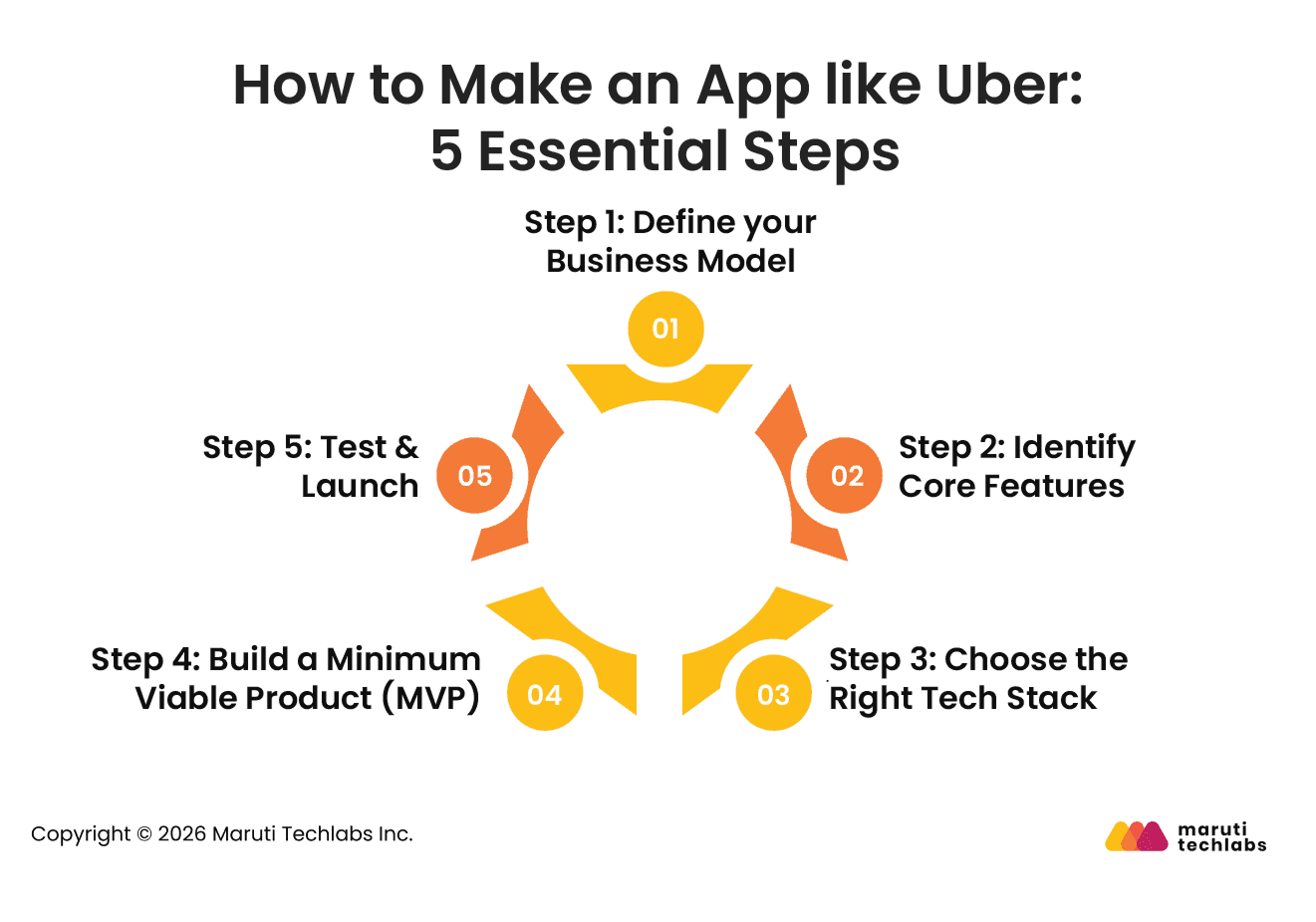
Step 1: Define Your Business Model
Start by identifying your target audience and the problem your app will solve. Decide how your platform will operate, whether it focuses on a specific city, niche audience, or unique offering. You should also outline how the app will generate revenue, such as through commissions, subscriptions, or dynamic pricing.
Step 2: Identify Core Features
Focus on building only the essential features required to launch and validate your idea. For passengers, this includes registration, ride booking, real-time tracking, payments, and ratings. For drivers, features like profile verification, ride requests, navigation, and earnings tracking are important, along with basic functionalities like notifications and fare calculation.
Step 3: Choose the Right Tech Stack
Select technologies that can support real-time performance and future scalability. Mobile apps can be built using frameworks like React Native or Flutter, while backend development can rely on Node.js or Python. Tools like Google Maps for navigation, Firebase for real-time updates, and cloud platforms such as AWS or Google Cloud help ensure smooth performance.
Step 4: Build a Minimum Viable Product (MVP)
Begin with a simplified version of the app by building an MVP that focuses only on core functionalities. Develop the passenger and driver apps along with an admin panel to manage users, trips, and payments. This approach helps you test your idea, gather feedback, and make improvements before scaling.
Step 5: Test & Launch
Before launching, thoroughly test the app to ensure it performs well under different conditions. Once ready, release it in a limited market, monitor user behavior, and refine the experience based on feedback. This helps build a stable foundation before expanding to a larger audience.
Which Programming Languages Are Used in Ride-Hailing Apps Like Uber?
Ride-hailing apps like Uber follow a polyglot architecture, where different programming languages are used across various components. Each layer, including frontend, backend, and data processing, is built using technologies best suited for performance, scalability, and reliability.
For real-time operations like dispatch, Node.js is often used because of its event-driven architecture, which handles high volumes of requests with low latency.
On the backend, a combination of Python, Go, and Java is commonly used. Python supports data processing and experimentation; Go handles high-performance and concurrent tasks; and Java powers scalable, enterprise-grade services.
In mobile development, iOS apps were initially built in Objective-C, while Android apps were built in Java, with Kotlin later adopted for better maintainability.
This multi-language approach helps ensure strong performance, scalability, and the ability to handle real-time demand efficiently.
System Architecture & Tech Stack for Uber-like Apps
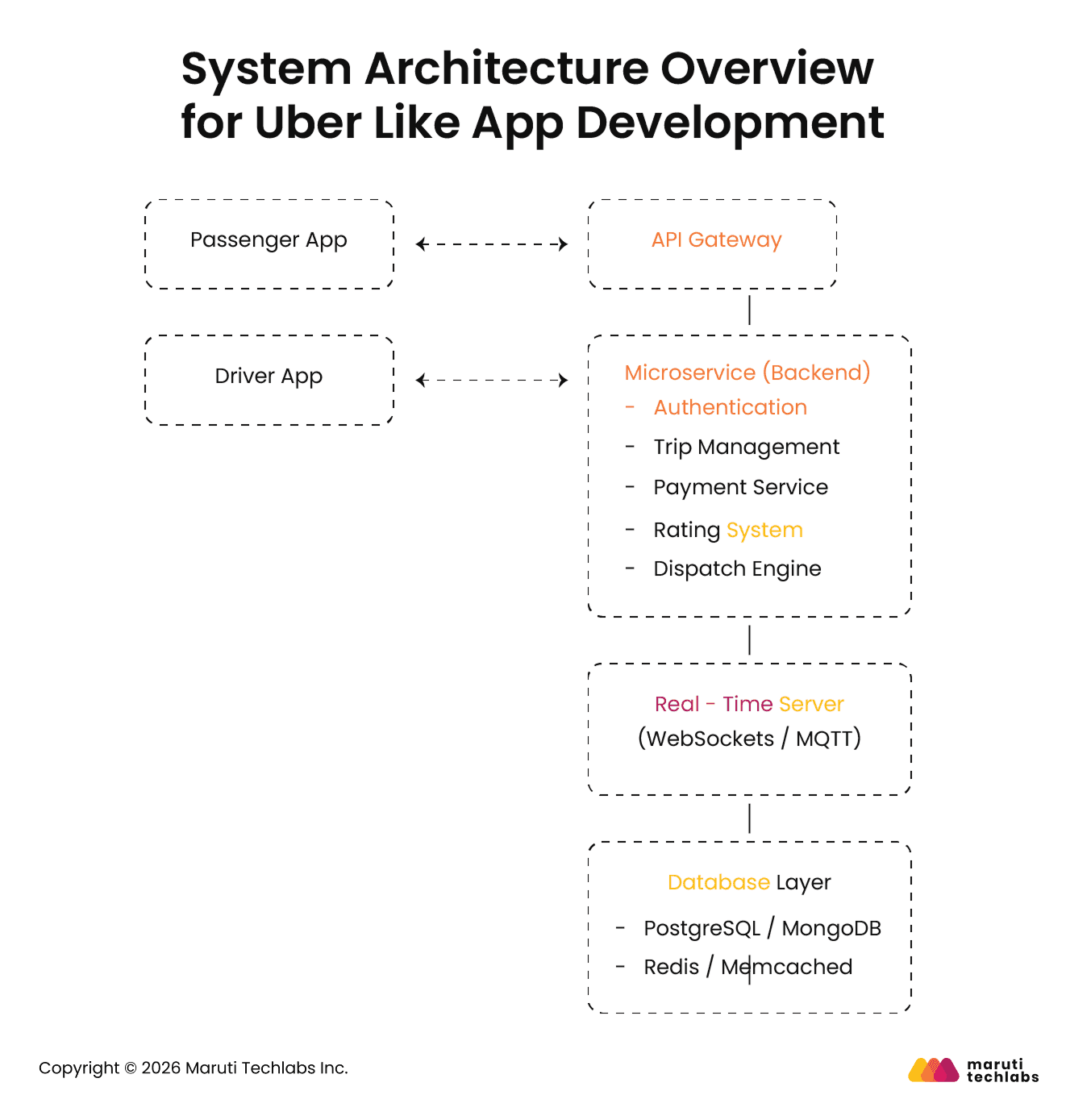
An Uber-like application is built on a microservices architecture that supports real-time operations, scalability, and independent handling of functions such as ride matching, payments, and location tracking. Its technology stack combines multiple programming languages, purpose-built databases, and cloud infrastructure to ensure consistent performance and reliability.
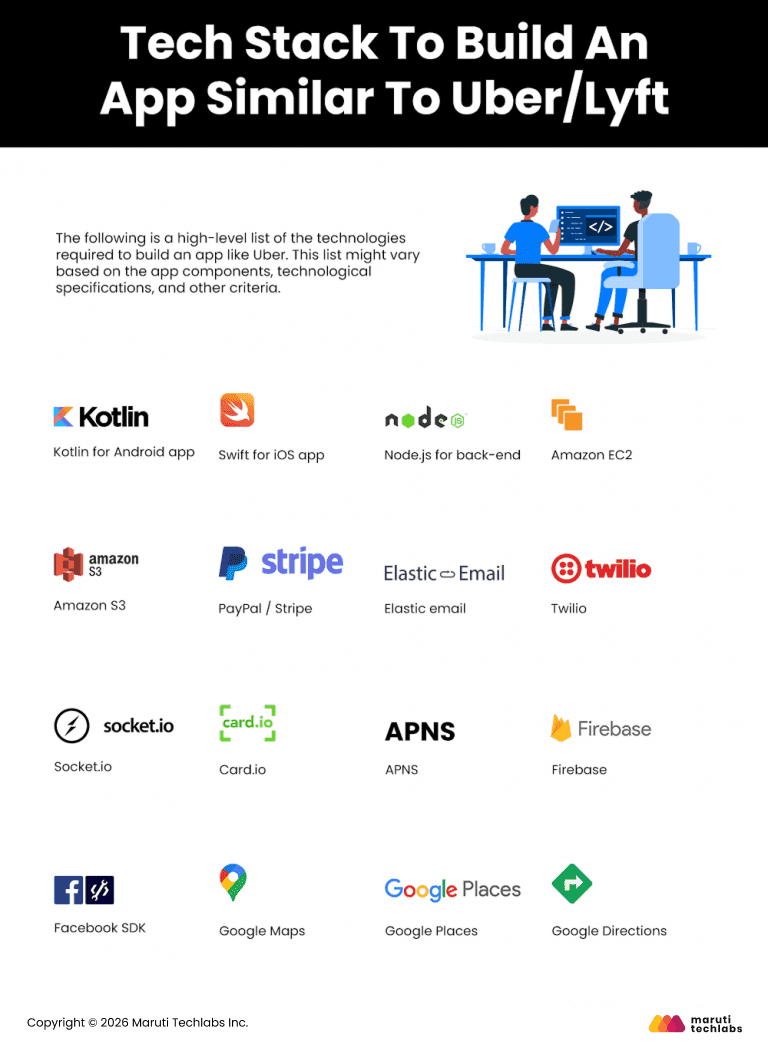
Tech Stack Breakdown to Make an App Like Uber
1. Frontend Technologies
Passenger & Driver Apps: React Native or Flutter (for cross-platform mobile development)
Admin Panel: React.js, Angular, or Vue.js (for web dashboard
2. Backend Frameworks
Node.js: Lightweight, event-driven, ideal for asynchronous operations (e.g., ride matching)
Go (Golang): High performance for microservices (like dispatch or payments)
Python: Useful for analytics, machine learning, or data-heavy operations
Java/Kotlin: Scalable enterprise-grade services.
3. Real-Time Communication
WebSockets: For two-way communication between users and drivers (live location tracking, ETA)
MQTT: Lightweight alternative for real-time messaging on mobile
PostgreSQL / MySQL: For structured user/trip/payment data
MongoDB: For flexible, schema-less data like trip logs
Redis / Memcached: For caching locations, pricing, and session data
5. Dispatch Algorithm
Custom Matching Logic: Uses geolocation + availability + traffic data
Geo-fencing: Helps assign drivers within specific zones
ETA-based Sorting: Prioritizes the nearest driver with the fastest ETA
Top 4 Monetization Models for Ride-Hailing Apps
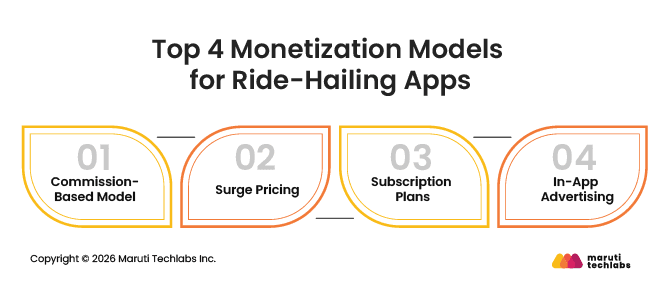
Ride-sharing platforms generate revenue through several models, including commissions on each ride, dynamic pricing during peak demand, subscription plans for drivers or riders, and in-app advertising or partnerships. In most cases, combining commission-based earnings with surge pricing helps create a more stable and scalable revenue stream.
Here are four effective models to choose from:
1. Commission-Based Model
This is the core revenue stream where the platform takes a percentage cut from every ride fare. For example, Uber typically charges drivers a 20–25% commission per trip.
2. Surge Pricing
Dynamic pricing is applied during high-demand periods (e.g., rush hours, bad weather). It incentivizes more drivers to get online and increases profits by raising fares.
3. Subscription Plans
Users can pay a fixed monthly fee for perks like discounted rides, priority booking, or zero cancellation charges. This model ensures recurring revenue and customer loyalty.
4. In-App Advertising
Displaying targeted ads to users in the app generates additional revenue. Brands can also partner to promote services, offers, or driver incentives
Challenges in Developing a Ride-Sharing App Like Uber and How to Overcome Them
Addressing the challenges of ride-sharing app development requires a strong and scalable foundation, supported by reliable cloud infrastructure, accurate location tracking, and secure payment systems. Platforms typically rely on services like AWS or Google Cloud for scalability, along with mapping solutions such as Google Maps or Mapbox, and trusted payment gateways to ensure smooth operations.
Addressing Development Challenges
Real-Time Location Accuracy: High-precision mapping APIs and real-time communication technologies help deliver accurate location updates with minimal delays.
Scalability and Performance: A modular architecture combined with cloud-based auto-scaling ensures the platform can handle high user demand without performance issues.
Driver-Rider Matching: Intelligent algorithms consider factors like distance, traffic conditions, and driver availability to assign rides efficiently and reduce wait times.
Payment Security and Integration: Secure payment gateways and well-designed backend systems enable smooth transactions across multiple payment methods while maintaining data security.
Regulatory Compliance: Adhering to local transportation laws, safety standards, and data privacy regulations is essential for operating in different regions.
Operational Considerations
Driver Onboarding: Building a strong driver network early on helps ensure better availability and shorter wait times for users.
User Experience: A simple and intuitive interface for both riders and drivers improves usability and overall engagement.
Testing and Quality Assurance: Thorough testing across performance, functionality, and security helps identify issues before launch and ensures a stable user experience.
Conclusion
To make an app like Uber, you need a clear business model, the right features, and a scalable technology foundation. Understanding how the platform works and choosing the right tech stack are essential steps to make an app that performs reliably. Starting with an MVP and refining it through testing helps build a strong foundation.
As you make an app in the ride-sharing space, focusing on performance, security, and user experience is critical. Addressing challenges like real-time tracking, scalability, and compliance early can prevent issues later. With the right approach, you can make an app that supports long-term growth and user satisfaction.
Why Choose Maruti Techlabs for Taxi App Development?
We help businesses build scalable, high-performance ride-sharing applications with the right mix of technical expertise and strategic guidance. Our capabilities span Software Development Services, Mobile App Development, and other digital solutions, enabling us to deliver applications that are reliable, user-focused, and built for real-world performance.
We have developed complex, location-based platforms such as a roadside assistance app with features like real-time tracking, service dispatch, and integrated payments. This hands-on experience gives us a strong understanding of building applications that handle real-time demand efficiently.
Our cross-functional team works with modern technologies like Flutter, Node.js, React, and AWS to build secure and scalable applications. Along with development, we support product strategy, MVP optimization, and post-launch enhancements to ensure long-term success.
FAQs for Taxi App Development
1. How long does it take to build a ride-sharing app like Uber?
Building a ride-sharing app typically takes around 3 to 4 months for a basic MVP with core features. A fully developed app with advanced functionality, integrations, and scalability can take 6 to 12 months, depending on project scope, team size, and the level of customization required.
2. What is the estimated cost to develop an Uber-like app?
The cost to develop an Uber-like app usually starts at around $25,000 for a basic MVP version. For a more advanced, scalable app with additional features, integrations, and high performance, the cost can exceed $150,000, depending on complexity, location of the development team, and overall project requirements.
3. Do I need separate apps for riders and drivers?
Yes, ride-sharing platforms typically require separate apps for riders and drivers to ensure a smooth and optimized experience for both. Additionally, an admin panel is needed to manage users, drivers, payments, and operations, making it easier to monitor performance and maintain control over the platform efficiently.
4. How do ride-sharing apps handle real-time tracking?
Ride-sharing apps use GPS-based mapping services such as Google Maps or Mapbox to track user and driver locations. These are combined with real-time communication technologies like WebSockets or Firebase to provide continuous location updates, ensuring accurate tracking, better route navigation, and improved overall user experience during rides.
5. How can I ensure the security of my ride-sharing app?
To ensure security, ride-sharing apps use encrypted payment gateways, secure authentication methods, and strong data protection practices. Features like OTP verification, secure APIs, and real-time ride tracking enhance user safety. Regular testing and compliance with data privacy regulations further help in protecting user information and maintaining platform trust.
6. How does a ride-hailing app like Uber work?
A ride-hailing app works through three systems: a passenger app, a driver app, and an admin panel. Users request rides, the system matches them with nearby drivers, and the trip is tracked in real time. After completion, payments are processed digitally, followed by ratings to maintain service quality and user trust.
7. What programming language does Uber use?
Uber’s engineers primarily write in Python, Node.js, Go, and Java. They started with two main languages: Node.js for the Marketplace team, and Python for everyone else.
8. How will my business benefit by implementing Uber for X?
Uber for X helps businesses tap into the growing on-demand economy by offering faster, more convenient services. It improves operational efficiency, streamlines workforce management, and enhances customer experience. With the right product strategy and technology, businesses can scale quickly, attract more users, and build a strong, loyal customer base.
9. How can I scale my ride-sharing app as the user base grows?
Scaling a ride-sharing app requires a cloud-based infrastructure, microservices architecture, and auto-scaling capabilities to handle increasing traffic. Optimizing databases, using load balancers, and improving real-time processing help maintain performance. Regular updates, monitoring, and feature enhancements also ensure the app continues to perform smoothly as demand grows.
Hamir Nandaniya leads product development and engineering across platforms, including Salesforce, web, and mobile. With over 20 years of experience across Java, Salesforce, AWS, and conversational bot development, he has spent his career bridging customer business needs with scalable technical solutions.
Stuck with a Tech Hurdle?
We fix, build, and optimize. The first consultation is on us!