Custom AI Vs Off-the-Shelf: Which Is Better For Your Business?
Explore how custom AI solutions can offer long-term benefits for your business.
Artificial Intelligence and Machine Learning
Custom AI Vs Off-the-Shelf: Which Is Better For Your Business?
Explore how custom AI solutions can offer long-term benefits for your business.
Table of contents
Table of contents
Introduction
Understanding the Difference Between Custom and Off-the-Shelf AI
When to Choose Off-the-Shelf AI Software?
When to Choose a Custom AI/ML Solution?
Advantages and Disadvantages of Custom AI
Advantages and Disadvantages of Off-the-Shelf AI
How do Custom and Off-the-Shelf AI Integrates with Cloud Platforms and Existing Systems?
5 Factors to Consider When Choosing an AI Solution for Your Business
Custom Vs. Off-the-Shelf AI: Cost, ROI, and Time to Market Comparison
Case Studies / Real World Examples
Building Custom AI: 6 Practical tips for enterprises
Conclusion
FAQs
Introduction
Artificial intelligence is becoming central to how modern businesses operate and compete. Companies are using intelligent systems to improve customer experience, streamline operations, increase productivity, and support decision-making.
As more industries adopt advanced automation, the ability to use artificial intelligence effectively is becoming a significant factor in long-term business success.
Selecting the correct artificial intelligence approach directly affects results, cost, and future readiness. A suitable solution supports growth, reduces risk, and delivers real business value.
A poor choice creates inefficiencies, limits performance, and increases expense over time. Companies must carefully evaluate their needs to ensure the selected artificial intelligence option supports their strategic goals.
Custom artificial intelligence is designed specifically for a company, while off-the-shelf artificial intelligence is a ready-made product. Custom systems align more closely with unique goals, while off-the-shelf tools are easier to adopt.
Understanding how each approach functions helps organizations choose the best path for performance, cost, and long-term value. This blog explains how custom and off-the-shelf AI solutions differ, where each option performs well, and what businesses should consider when choosing.
Understanding the Difference Between Custom and Off-the-Shelf AI
What is Custom AI?
Custom artificial intelligence is a solution created for the specific needs of an individual business. It reflects unique processes, data, and goals.
The design allows deep alignment with internal workflows. Because it is built from the ground up, it can solve highly specialized problems that standard tools cannot address effectively.
What is Off-the-Shelf AI?
Off-the-shelf AI is a ready-made tool designed for broad usage across many industries. It includes set features that allow fast adoption with minimal effort.
These solutions suit everyday needs and offer proven performance. They help organizations access artificial intelligence quickly without developing new systems from scratch.
Custom Vs. Off-the-Shelf AI: Key Distinctions in Functionality, Flexibility, and Cost
Custom artificial intelligence delivers higher functionality because it is tailored for specific use cases and can evolve with business needs. It offers greater flexibility, as features can be adjusted as processes change.
Off-the-shelf artificial intelligence offers fixed functionality with limited options for modification. Custom solutions usually require higher investment due to design and development, while off-the-shelf products typically use subscription-based pricing that reduces upfront costs.
Custom tools support unique competitive strategies while off-the-shelf products support general improvements across everyday tasks. The main difference is the extent to which each option aligns with long-term business goals.
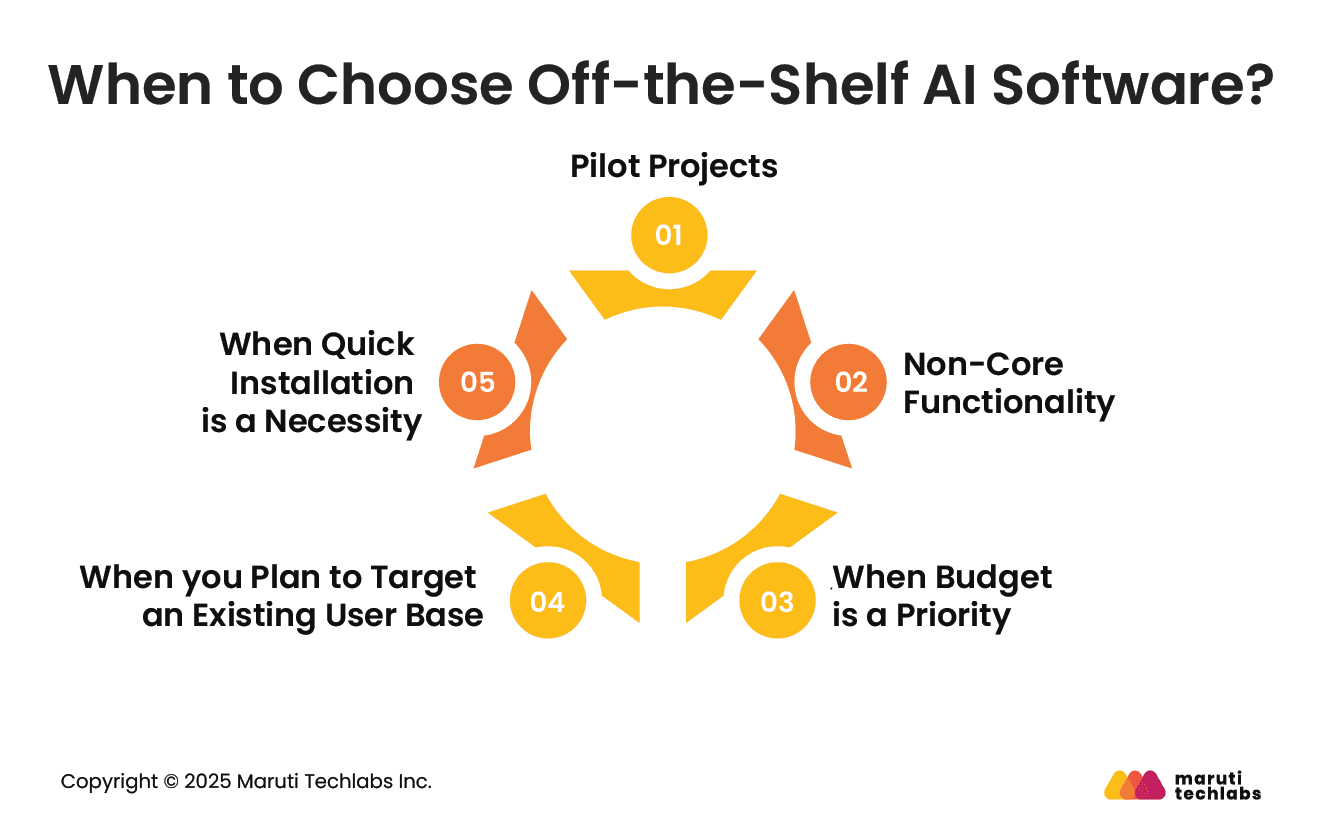
When to Choose Off-the-Shelf AI Software?
Here are some scenarios that best capture the need for off-the-shelf software.
1. Pilot Projects
Using ready-to-use AI software is the right choice if you’re just commencing your AI journey and want to learn the value it offers. It helps you validate your use cases without breaking the bank.
For example, a customer support team might integrate an off-the-shelf sentiment analysis API with their ticketing system to automatically flag negative or urgent messages.
2. Non-Core Functionality
If the AI software you choose doesn’t concern your core business requirements, off-the-shelf software is usually preferable. For example, there is no merit in developing a custom AI-powered meeting recorder. Only invest in AI where it differentiates your product.
3. When Budget is a Priority
Custom AI/ML solutions require licences that have high costs. With off-the-shelf software, the licensing cost is split among thousands of buyers, and one only needs to pay a one-time activation fee. So, using ready-to-use software is always a cheaper alternative.
4. When you Plan to Target an Existing User Base
Off-the-shelf software generally has a pre-existing user base, popularity, and high adoption. This helps organizations leverage the pre-built community to market their products and services.
5. When Quick Installation is a Necessity
Off-the-shelf software is already available on the market. Unlike custom AI software, this approach reduces the time and resources needed to plan, build, and deploy. One can easily purchase and install a ready-to-use software following simple steps. This makes them a convenient choice.
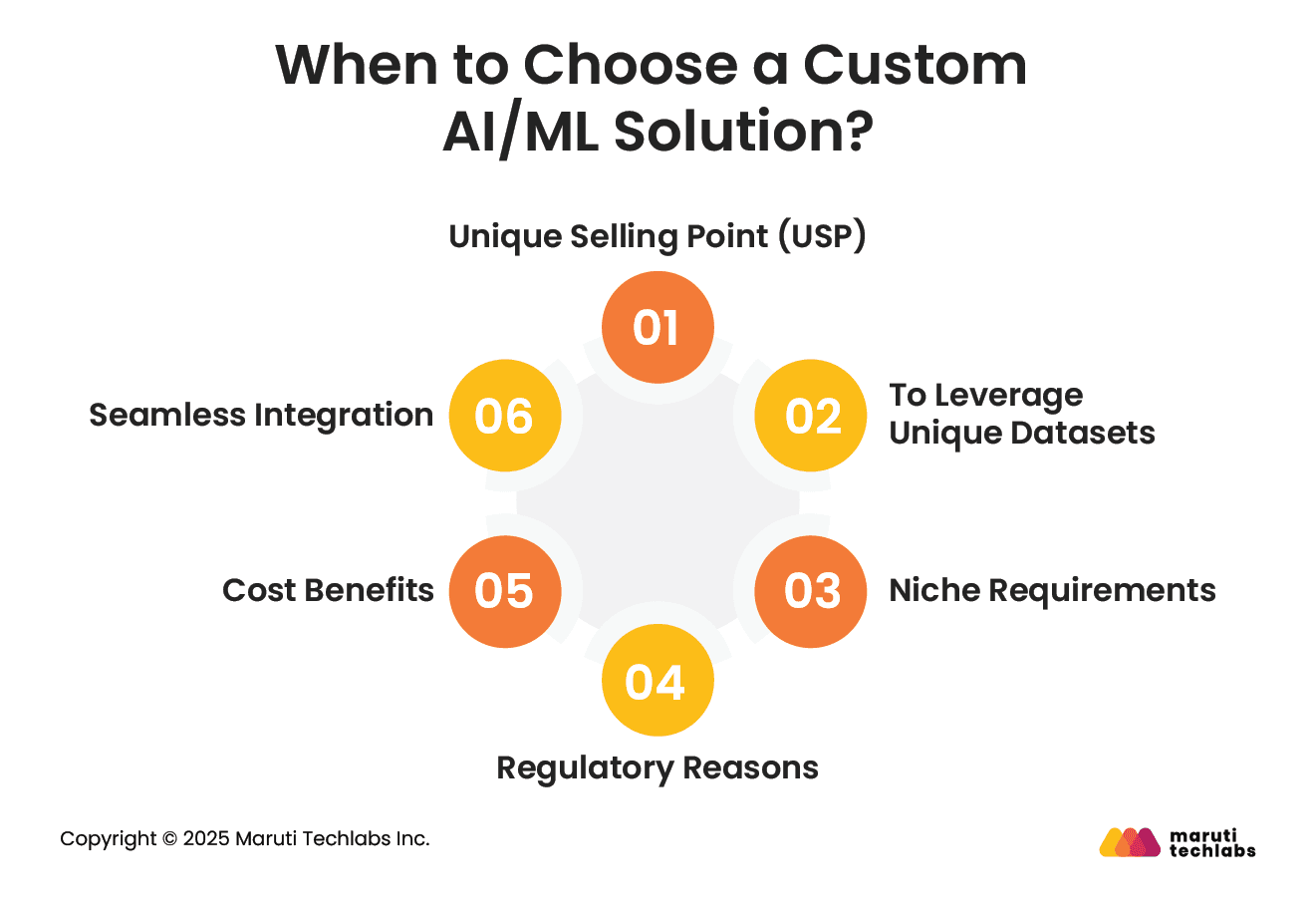
When to Choose a Custom AI/ML Solution?
Here are some conditions that necessitate custom AI development.
1. Unique Selling Point (USP)
A primary reason to invest in custom AI is if it delivers exquisite value and competitive advantage for your product or service. For example, if you own a hospital and need to summarize thousands of medical records, creating an AI-powered medical record summarization tool would serve you best. Having such capable technology can offer you a significant competitive advantage.
2. To Leverage Unique Datasets
If you have heaps of unique datasets for a specific domain or industry that can be fed into an AI model, a custom solution is the only option. Off-the-shelf software wouldn’t be able to offer the functionality you need to train your model with the data you possess.
Your bespoke model trained on niche data can offer results that ready-to-use models simply cannot match. This includes increased accuracy and specific insights. B2B companies, such as logistics or healthcare, mainly prefer such solutions.
3. Niche Requirements
At times, the latency, accuracy, and integration requirements are what off-the-shelf software cannot offer. The API response time may be high, the model is 10% less accurate than what you need, or the model only works well on the cloud. Custom AI solutions are the perfect way to move beyond the limitations of readily available software.
4. Regulatory Reasons
Industries such as healthcare and legal, which must adhere to numerous legal regulations, often find that custom AI provides an easier way to meet all compliance criteria. If you need to exercise control over data sovereignty, algorithm auditability, and compliance with strict standards, you're likely better off building a custom solution.
Off-the-shelf vendors might not be able to offer the deployment models or certifications you require. Custom software provides the freedom to design your niche model and ensure overall compliance.
5. Cost Benefits
If you have to use AI tools extensively, you must calculate the build vs buy costs. For many businesses, continual use of an external API can prove to be costlier than in-house solutions.
For instance, if you process millions of AI inferences daily, running your model on cloud instances can be a more cost-effective option. Here, investing in custom development can be a sound strategy considering long-term costs. In addition, your investments in custom AI are increasing the long-term value of your company and aren’t a waste of spend.
6. Seamless Integration
Custom AI software can offer seamless integration with your current systems and workflows. You can design your interfaces as required, make it compatible with legacy infrastructure, and avoid disruptions that often accompany an external tool.
If you’ve had adverse experiences with off-the-shelf software, you might be aware of the hidden costs associated. Also, you don't need to request that any vendor add a new feature. If you want, your team can create it without needing a third-party provider.
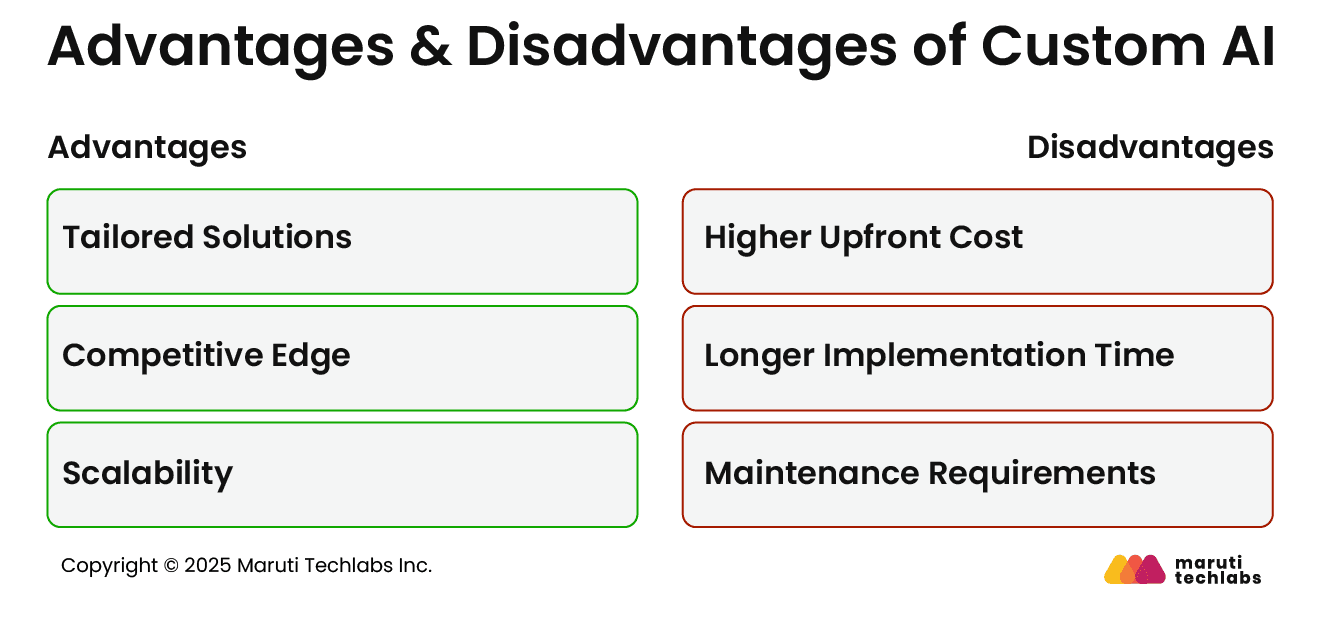
Advantages and Disadvantages of Custom AI
Advantages
1. Tailored Solutions
Custom artificial intelligence is designed to meet a business's exact needs. It aligns with specific processes, data types, customer expectations, and industry rules.
Because it fits the organization precisely, it improves accuracy and efficiency. The close match between technology and workflow delivers substantial long-term operational and financial benefits.
2. Competitive Edge
A custom artificial intelligence system supports unique capabilities that other companies cannot easily copy. It reflects the business vision and creates specialized strengths.
This helps the organization stand out in the market, serve customers better, and build a clear advantage. Such differentiation leads to stronger performance and contributes to long-term growth.
3. Scalability
Custom artificial intelligence can grow with the organization since it is built to adjust over time. New features can be added as needs evolve and data expands.
This supports continued improvement without replacing the system. Companies gain a stable foundation that supports increasing demands while maintaining control over performance and capability.
Disadvantages
1. Higher Upfront Cost
Custom artificial intelligence requires significant investment because it involves planning, design, development, testing, and continued improvement. The cost also reflects the need for technical specialists and dedicated resources.
While the solution may deliver substantial value over time, the initial financial commitment is higher than many businesses expect or can allocate immediately.
2. Longer Implementation Time
Building custom artificial intelligence takes time because it involves analysis, development, testing, and refinement. The process must ensure accuracy and alignment with business needs.
As a result, deployment may take several months. This slower timeline can delay benefits for organizations that require immediate results or have limited time for implementation.
3. Maintenance Requirements
Custom artificial intelligence systems need ongoing care to stay accurate and valuable. They require updates, monitoring, and improvement as data and processes change.
This adds long-term responsibility for technical teams. Without regular maintenance, performance may decline. Businesses must be ready to manage this continuing effort to sustain results.
Ideal Business Scenarios for Custom AI
Custom artificial intelligence is ideal for businesses with unique processes, specialized data, or complex goals. It suits organizations seeking long-term competitive advantage through tailored capabilities.
Companies with substantial budgets, dedicated teams, and long planning cycles benefit most. It also supports enterprises that require deep integration with internal systems.
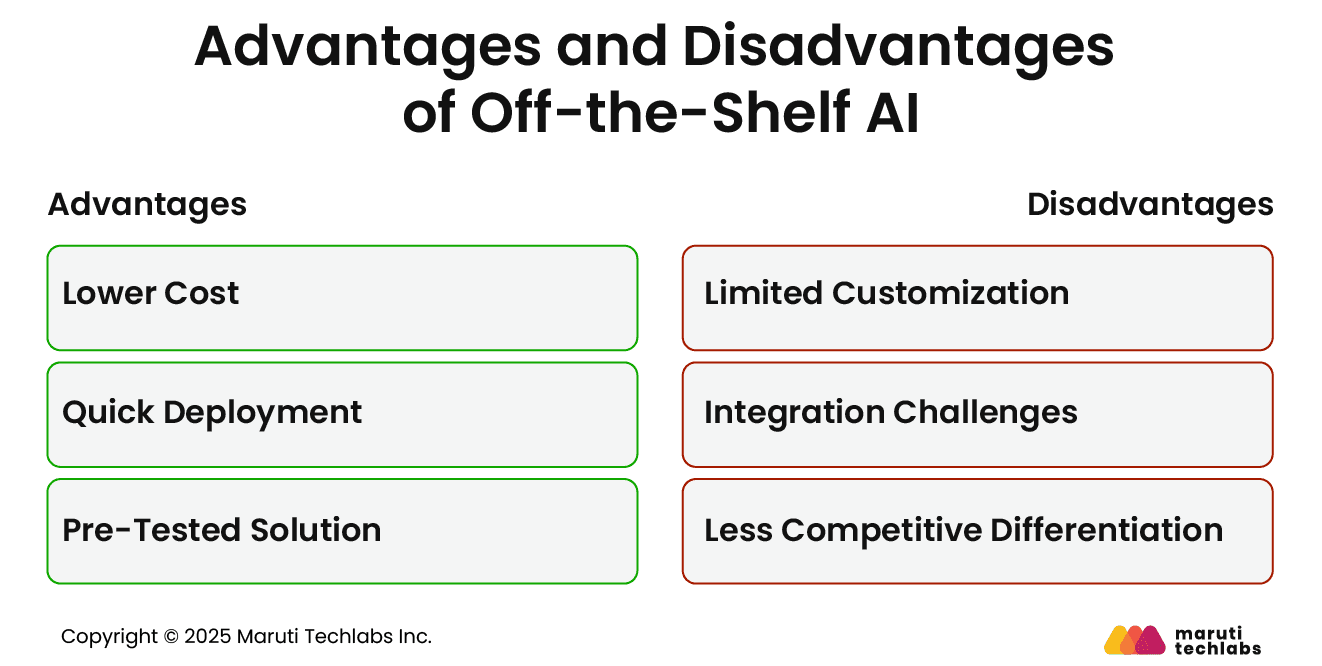
Advantages and Disadvantages of Off-the-Shelf AI
Advantages
1. Lower Cost
Off-the-shelf artificial intelligence reduces initial spending because it is sold as a ready-made product. Companies avoid the cost of development and customization.
The pricing model allows easy budgeting and predictable expenses. This approach is attractive for businesses seeking to access artificial intelligence without significant financial commitments or technical investment.
2. Quick Deployment
Off-the-shelf artificial intelligence offers immediate access because it is already built. Companies can install and use it with minimal setup.
This allows faster results and helps teams adopt artificial intelligence without waiting months for development. Rapid deployment supports time-sensitive projects and organizations that need quick performance improvements.
3. Pre-Tested Solution
Many customers use off-the-shelf artificial intelligence tools, which means they have already been tested in real-world environments. This reduces risk and provides confidence in performance.
Businesses receive reliable features, documented guidance, and stable updates. These proven systems make adoption easier and support consistent results across everyday business needs.
Disadvantages
1. Limited Customization
Off-the-shelf artificial intelligence offers set features that may not match specific business needs. Companies cannot make profound changes to the system, which limits alignment with unique processes.
This can create performance gaps or require workarounds. The lack of flexibility makes it difficult to build specialized capabilities that support differentiation.
2. Integration Challenges
Connecting off-the-shelf artificial intelligence with existing systems can be challenging because each business has distinct data structures and workflows.
These tools follow general standards that may not align with internal platforms. This mismatch increases effort during setup. Poor integration can reduce efficiency and limit the value the solution can provide.
3. Less Competitive Differentiation
Since off-the-shelf artificial intelligence is available to many organizations, it cannot create a unique advantage. Competitors may use the same features and achieve similar results.
This limits the ability to stand out in the market. Companies gain efficiency but do not gain exclusive capabilities that support long-term strategic distinction.
Ideal Business Scenarios for Off-the-Shelf AI
Off-the-shelf artificial intelligence suits companies with everyday needs, limited budgets, or tight timelines. It works well for standard operations, small teams, and organizations beginning their journey into artificial intelligence.
It also fits businesses that need fast improvements without deep customization or long development cycles. This approach supports practical and immediate adoption.
How do Custom and Off-the-Shelf AI Integrates with Cloud Platforms and Existing Systems?
Custom artificial intelligence integrates deeply with internal systems because it is designed to match existing workflows. It connects smoothly with data sources, cloud platforms, and applications to support precise operations.
Off-the-shelf artificial intelligence integrates through general methods that may require adjustment or additional tools. While many products support common cloud platforms, they may not meet unique system requirements, increasing setup time.
Custom solutions offer complete alignment while off-the-shelf tools provide basic connectivity. The choice depends on the complexity of existing technology environments and the level of control over integration a business requires for long-term stability.
1. Data Security and Compliance Implications
Custom AI supports strict data security, as controls can be designed to align with organizational rules and industry requirements. Sensitive information remains protected through tailored access and monitoring features.
Off-the-shelf AI follows standard security practices that may not fit unique compliance needs. Businesses must evaluate how these tools store, process, and protect information.
Custom systems offer greater control over data locations and policies, while off-the-shelf products rely on preset safeguards. The decision depends on the level of sensitivity, regulatory responsibilities, and internal governance required to protect data and maintain stable, compliant operations.
2. Long-Term Scalability and Flexibility
Custom AI delivers strong long-term scalability because it can evolve as business operations expand. New features, data sources, and performance improvements can be added when needed.
Off-the-shelf artificial intelligence offers limited flexibility because scaling is limited to what the vendor supports. As demands grow, these limits can affect performance or require additional tools.
Custom solutions support continuous improvement without replacing the system, while off-the-shelf products may require upgrades or alternative solutions. Companies must choose based on growth plans, expected data expansion, and the level of control needed to adjust systems over time.
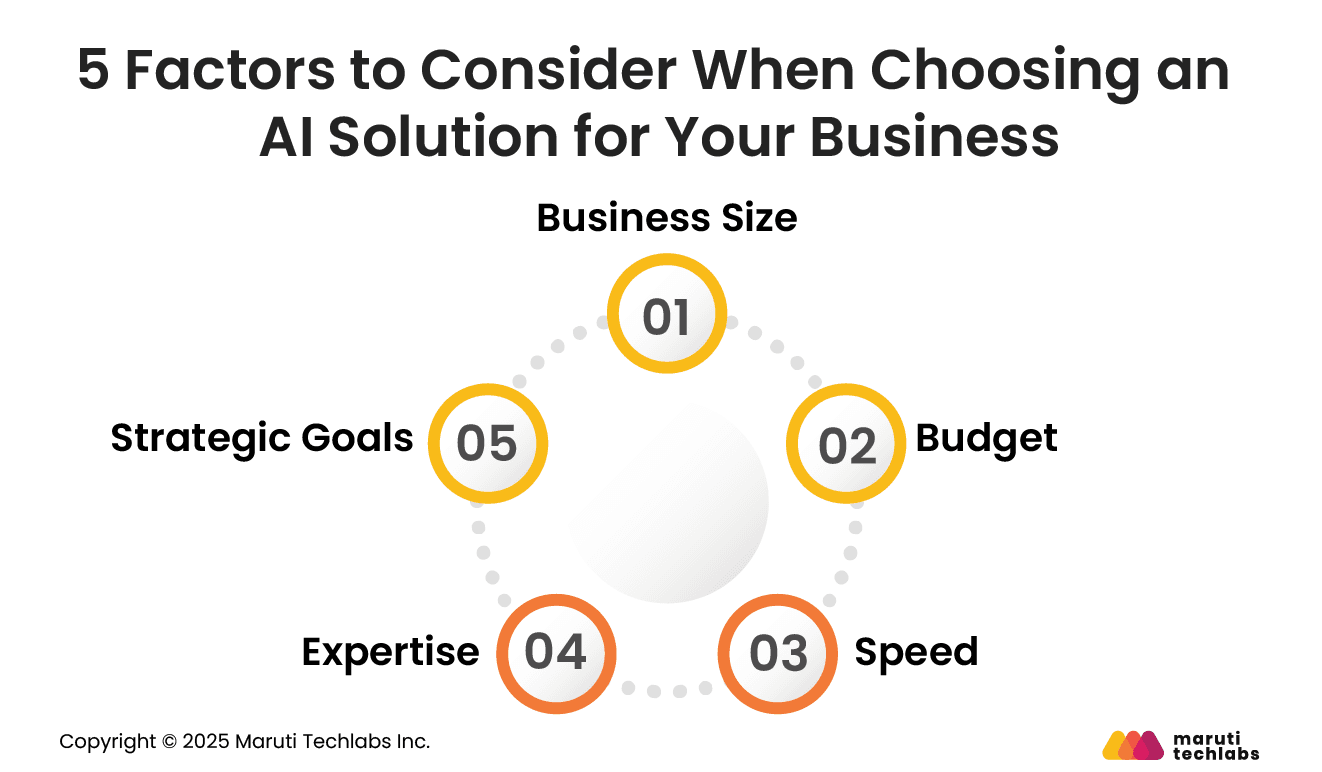
5 Factors to Consider When Choosing an AI Solution for Your Business
Selecting the correct artificial intelligence approach requires a clear understanding of goals, resources, and timelines. Businesses should evaluate each option based on needs, capacity, and expected long-term value.
1. Business Size
Large organizations with complex operations often benefit from custom artificial intelligence, as it aligns with their detailed processes. Smaller companies may prefer off-the-shelf products because they are simpler to adopt.
Medium-sized businesses should evaluate growth plans and resource availability to determine which option will best support future expansion.
2. Budget
Budget plays a significant role in selecting artificial intelligence. Companies with limited resources may choose off-the-shelf tools to reduce early expenses.
Organizations with larger budgets can invest in custom systems that deliver long-term value. The decision must balance cost, expected return, and the importance of tailored performance.
3. Speed
Businesses requiring rapid implementation often select off-the-shelf artificial intelligence because it is ready-to-use. Companies with more flexible timelines may choose custom solutions to gain deeper alignment.
Evaluating project urgency, expected benefits, and internal readiness helps determine which approach supports the desired speed of execution.
4. Expertise
Off-the-shelf artificial intelligence suits organizations with limited internal technical expertise since it requires minimal setup and management. Custom systems need skilled teams for development and ongoing improvement.
Companies must assess their ability to support complex solutions before making a choice. Adequate knowledge ensures successful adoption and long-term performance.
5. Strategic Goals
Custom artificial intelligence is ideal when technology must support unique strategies or create long-term differentiation. Off-the-shelf tools support operational efficiency and fast improvement.
Businesses should consider whether their goals prioritize innovation or stability and cost control. This helps identify the solution that best aligns with the future direction.
Custom Vs. Off-the-Shelf AI: Cost, ROI, and Time to Market Comparison
Custom AI
1. Development Cost
Custom artificial intelligence requires significant investment in development because it involves planning, design, engineering, testing, and ongoing improvement. Costs increase when projects demand advanced features or complex data handling.
This investment creates a powerful system but requires careful budgeting. Organizations must ensure they have the financial capacity to support long-term delivery.
2. Long-Term ROI
Although custom artificial intelligence requires higher upfront investment, it often delivers greater value over time. Tailored performance reduces waste, improves accuracy, and supports unique capabilities that produce measurable gains.
The system scales with the business, increasing durability. Over the years, the return may exceed that of standard solutions through sustained strategic impact.
Off the Shelf AI
1. Subscription or Licensing Cost
Off-the-shelf artificial intelligence uses predictable subscription or licensing fees, reducing upfront costs. Businesses can manage costs easily because fees follow clear schedules.
This financial model supports budget control and lowers risk. It allows companies to adopt artificial intelligence without significant capital investment or long-term resource commitment.
2. Faster ROI
Ready-made artificial intelligence delivers results quickly because deployment is immediate. Businesses see productivity gains within weeks and can measure value early.
The lower cost and faster implementation shorten the payback period. This helps organizations that require urgent improvements or want to demonstrate quick success with limited financial risk.
When Higher Upfront Cost Makes Sense with Custom AI?
A higher initial investment is justified when a business needs specialized capabilities, strict accuracy, or deep integration that off-the-shelf tools cannot provide. Custom solutions support complex workflows and long-term growth.
When long-term value outweighs short-term cost, choosing custom artificial intelligence becomes a strategic and financially sound decision.
Case Studies / Real World Examples
Real-World Successful Custom AI Implementation
Walmart developed its own custom artificial intelligence logistics system that optimizes delivery routes and inventory operations.
By using proprietary models tailored to its supply chain data, Walmart reduced driver miles and logistical costs while improving delivery reliability and environmental outcomes, demonstrating how tailored AI systems can enhance operational efficiency and competitive strength.
Real-World Successful Off-the-Shelf AI Implementation
Cognizant, Infosys, TCS, and Wipro deployed Microsoft Copilot licenses as a ready-made AI solution across operations to enhance productivity and support enterprise transformation.
These companies quickly applied off-the-shelf AI tools to empower large workforces with intelligent assistance and automation, without lengthy custom development timelines.
Lessons and Takeaways
Custom artificial intelligence delivers a strategic advantage when deeply aligned with core processes and data, as seen at Walmart.
Off-the-shelf AI enables rapid deployment and broader user adoption, as major technology services firms have experienced. The choice depends on how critical unique workflows or immediate value creation are to the organization’s goals.
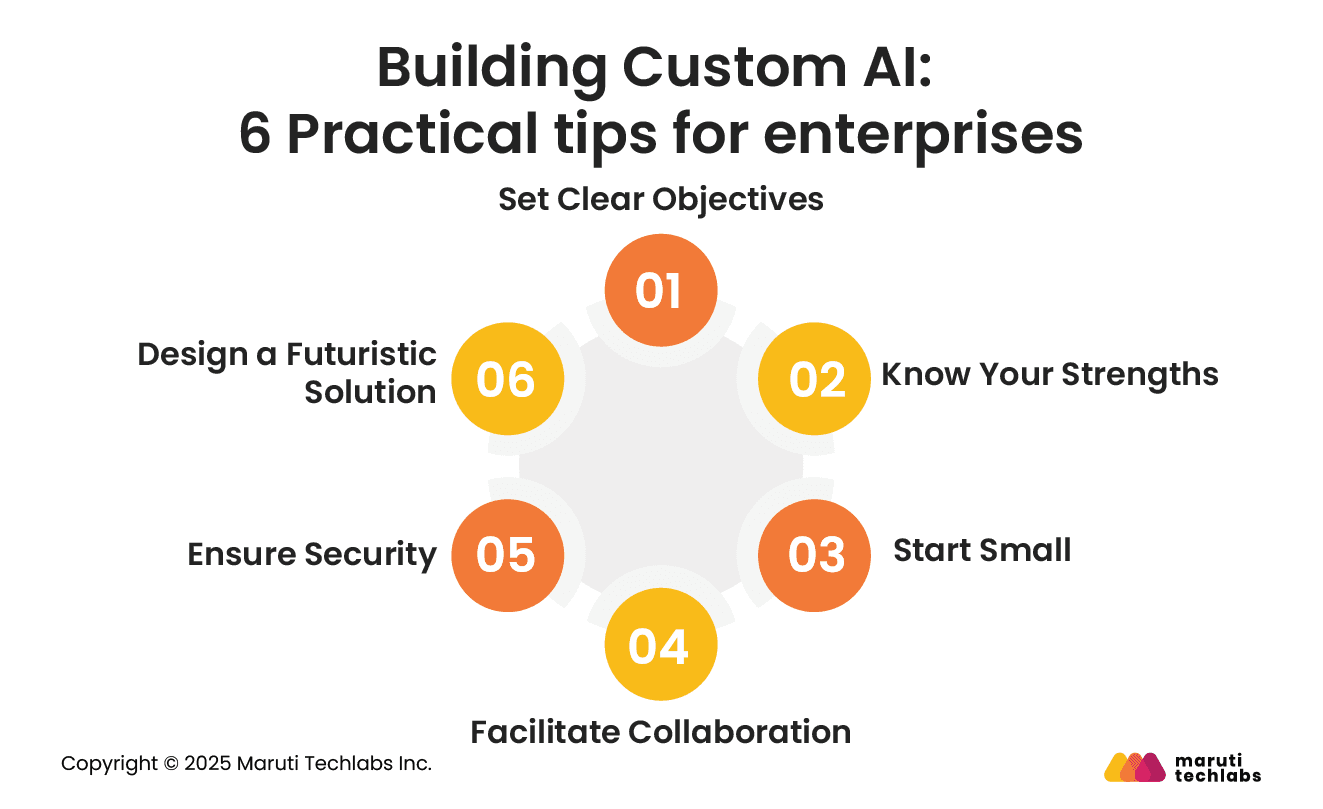
Building Custom AI: 6 Practical tips for enterprises
1. Set Clear Objectives
Start by documenting clear objectives for artificial intelligence and ensuring all stakeholders understand expected outcomes. This helps align technology choices with business goals and prevents confusion during evaluation or implementation phases.
2. Know Your Strengths
Evaluate internal technical skills early to avoid unexpected challenges. Knowing team strengths and limitations ensures realistic planning and helps select an artificial intelligence approach that aligns with organizational capabilities and support capacity.
3. Start Small
Begin with a small initiative to test assumptions and measure value. Early results provide insight into performance, usability, and return on investment, which helps guide larger investments in future artificial intelligence deployments.
4. Facilitate Collaboration
Engage business and technology teams in the decision process. Collaboration ensures the final artificial intelligence solution supports operational needs, reduces friction, and strengthens adoption across departments and processes.
5. Ensure Security
Review security and compliance requirements before selection. Understanding data sensitivity and regulatory responsibilities ensures the artificial intelligence solution meets standards and avoids risk related to information protection or legal obligations.
6. Design a Futuristic Solution
Consider long-term system expansion during evaluation. Selecting an artificial intelligence solution that scales with the business prevents disruption and reduces future costs while ensuring performance remains strong as data and operations grow.
Conclusion
Choosing between custom AI and off-the-shelf software ultimately depends on your business goals, budget, and scalability needs.
Off-the-shelf tools offer speed and affordability, but they often come with performance limits and unused features. Custom AI solutions, while more resource-intensive, deliver higher accuracy, greater efficiency, and long-term ROI through tailored functionality.
Not sure where to begin? Start with our AI Readiness Assessment Tool to evaluate your organization's preparedness and identify the right AI approach.
Maruti Techlabs’ Machine Learning Services can help you bridge this gap. With expertise in building data-driven, industry-specific AI models, we design solutions that align perfectly with your workflows, whether it’s predictive analytics, automation, or advanced decision support. From strategy and prototyping to deployment and optimization, our Custom AI Development ensures your AI investment drives measurable business impact.
If you’re ready to transform operations and gain a competitive edge, schedule a free consultation or connect with us to explore our AI & ML services today. Let’s create an AI solution that works wonders for your business.
FAQs
1. Which three tools are commonly used for hyperparameter optimization in AI-ML models?
Ans) Popular tools include Optuna, known for its efficient sampling and pruning strategies. Ray Tune, offering distributed hyperparameter tuning for large-scale workloads. And Hyperopt, which uses Bayesian optimization to find optimal configurations. These tools help improve AI/ML model performance while minimizing manual experimentation time and resource use.
2. What are some of the considerations when using voice data in developing AI/ML models?
Ans) When developing AI/ML models with voice data, consider audio quality, noise reduction, and sampling rate consistency. Address privacy and data consent regulations, especially under GDPR or HIPAA.
Account for language diversity, accents, and speaker variability to avoid bias and ensure model robustness across different demographics and speaking environments.
3. What are the best enterprise edge platforms for running AI/ML inference models?
Ans) Leading enterprise edge platforms include NVIDIA Jetson (high-performance GPU-accelerated inference), Azure IoT Edge (cloud-integrated edge AI), and AWS IoT Greengrass (secure, offline-capable edge processing).
These platforms enable low-latency, scalable AI/ML inference close to data sources, reducing bandwidth costs and supporting real-time decision-making in production environments.
4. Is custom AI better than off-the-shelf?
Custom artificial intelligence is better when a business needs specialized capabilities, unique processes, or a strong competitive advantage. Off-the-shelf artificial intelligence is better for quick results and lower cost.
The correct option depends on goals, budget, timeline, and internal skills. Neither solution is universally better without proper evaluation.
5. How much does custom AI cost?
The cost of custom artificial intelligence depends on complexity, data needs, features, and required expertise. Projects may require significant investment due to design, development, and maintenance work.
Small solutions cost less, while large systems require greater investment. Accurate estimates require a detailed analysis of goals, scope, and long-term technical requirements.
6. Which businesses benefit from off-the-shelf AI?
Off-the-shelf artificial intelligence benefits companies with everyday needs, limited budgets, or urgent timelines. It suits small and mid-sized firms seeking fast improvements without deep customization.
It also supports organizations beginning their artificial intelligence journey and those wanting predictable costs and a simple setup with minimal technical effort.
Pinakin Ariwala has over 20 years of experience in AI/ML, data engineering, and software development. He has led AI and machine learning projects across industries, including agriculture, finance, and healthcare, and has been featured on the Clutch Leaders Matrix podcast discussing real-world AI/ML applications.
Stuck with a Tech Hurdle?
We fix, build, and optimize. The first consultation is on us!