SDET 2026: Everything You Need to Know About the Role, Skills & Pay
Explore the growing need for SDETs in modern testing and understand how their role differs from traditional QA testers.
QA
SDET 2026: Everything You Need to Know About the Role, Skills & Pay
Explore the growing need for SDETs in modern testing and understand how their role differs from traditional QA testers.
Table of contents
Table of contents
Key Takeaways
Introduction
What is an SDET?
The Origin and Evolution of the SDET Role
The Role of an SDET in 2026
SDET vs QA Tester vs Developer
Why the Demand for SDETs is Growing in 2026
How AI is Impacting the Role of SDET in 2026
SDET Career Path and Growth Opportunities
Essential Skills for SDETs in 2026
SDET Salary Trends in 2026
How to Become an SDET: A Roadmap
Real-World Job Examples
Conclusion
Why Maruti Techlabs for SDET and Automation Testing
FAQs
Key Takeaways
SDETs have evolved into core engineering roles responsible for building automation-first quality systems across the software lifecycle.
The role goes beyond testing, covering framework development, CI/CD integration, API validation, and performance testing.
AI-powered testing tools are transforming how SDETs design, execute, and optimize test strategies.
Demand for SDETs is rising due to the adoption of DevOps, microservices, and continuous testing practices.
Career progression spans from Junior SDET to Automation Architect and QA leadership roles.
SDETs command high salaries globally due to their hybrid expertise in development and testing.
SDETs play a critical key role in reducing defects, accelerating releases, and improving system reliability at scale.
Strong programming skills, automation expertise, and knowledge of cloud and CI/CD tools are essential to succeed.
Introduction
Software delivery has gained unprecedented speed and complexity in 2026. Recent industry data shows that automated testing coverage exceeds 74% in modern CI/CD pipelines.
This change has fundamentally redefined software quality.
Testing is no longer a phase that follows development. It is embedded into every stage of the lifecycle. As a result, organizations need professionals who can combine development expertise with testing strategy.
This is where the role of Software Development Engineers in Test (SDETs) has become indispensable.
SDETs enable organizations to release faster, reduce production defects, and build resilient systems by embedding automation into development workflows. Since businesses steadily invest in automation testing services, the demand for SDETs is accelerating across industries, especially as AI, DevOps, and microservices continue to evolve.
This blog explores the SDET role in depth, covering responsibilities, tools, career progression, real-world job examples, salary trends, and the growing impact of AI and DevOps on modern testing.
What is an SDET?
A Software Development Engineer in Test (SDET) is a developer who focuses on testing. They build automated tests, frameworks, and tools to improve software quality and ensure faster, reliable releases.
As opposed to traditional QA roles, SDETs focus on building frameworks, writing reusable test scripts, and integrating testing into CI/CD pipelines, similar to the role QA plays in CI/CD pipeline workflows.
The Origin and Evolution of the SDET Role
The SDET role originated out of necessity rather than design.
In the early 2000s, companies like Microsoft and Amazon began scaling software systems at a pace that traditional QA processes could no longer keep up with. Manual testing cycles were too slow, error-prone, and disconnected from development workflows.
To solve this, these companies introduced a new kind of engineer. Someone who could write production-level code while also building automated testing systems.
This marked the birth of the Software Development Engineer in Test.
Initially, SDETs focused on replacing repetitive manual testing with automation scripts. However, as software systems became more complex, especially with the rise of cloud computing and distributed architectures, the role changed considerably.
In 2026, SDETs are no longer just automation engineers. They are quality engineers responsible for crafting scalable testing ecosystems.
This evolution can be understood in three stages:
Automation Phase: Focused on reducing manual effort through scripted testing.
Framework Engineering Phase: Shifted toward building reusable, maintainable test frameworks that could support large applications.
Quality Engineering Phase (Current): SDETs now own end-to-end quality, including test strategy, CI/CD integration, observability, and even production validation.
In contrast to traditional QA roles, SDETs are embedded within development teams. They participate in sprint planning, contribute to code reviews, and influence architectural decisions to improve testability.
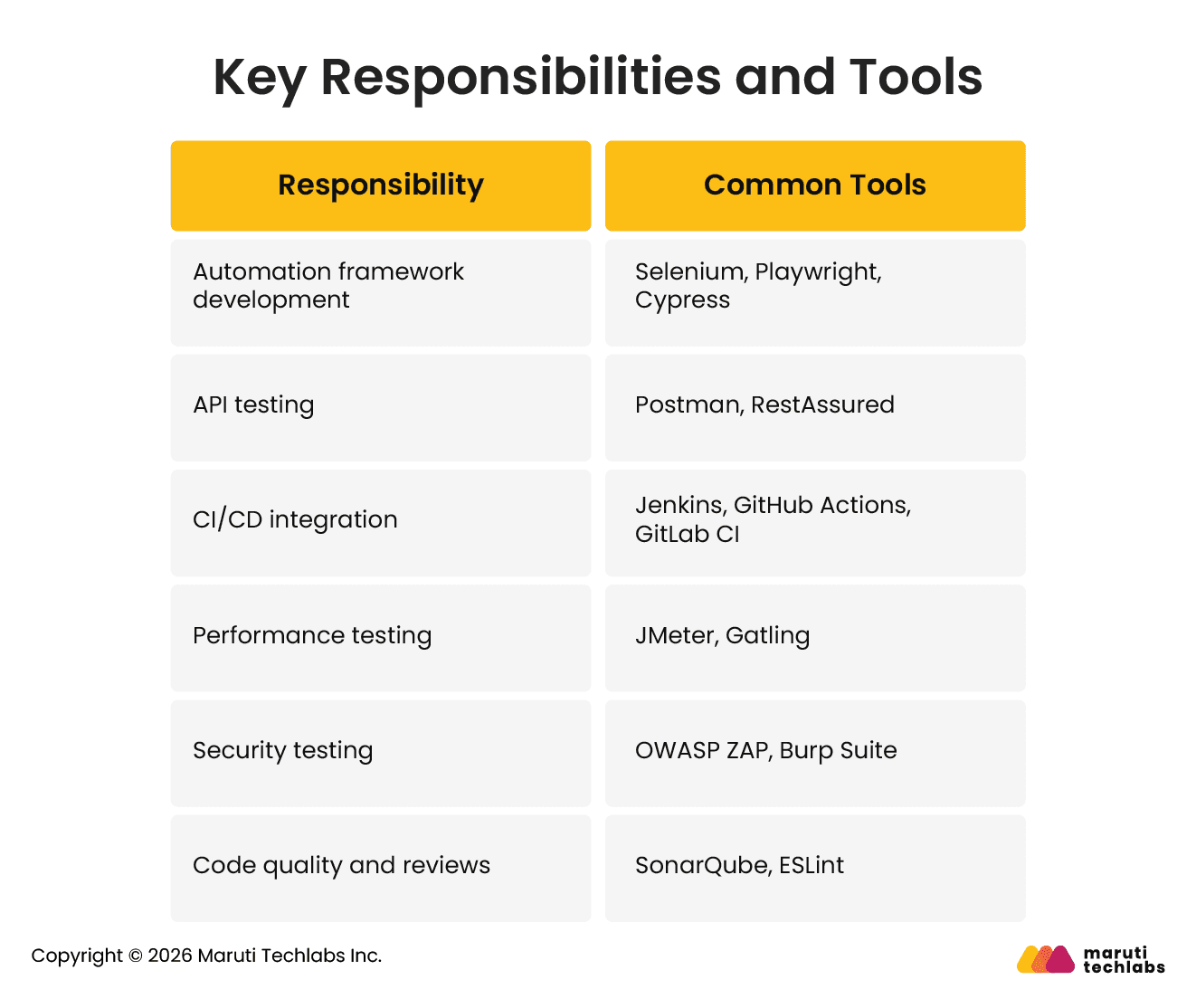
Key Responsibilities and Tools of an SDET Role
SDET key responsibilities and tools include designing, building, and managing end-to-end testing systems that support modern software delivery.
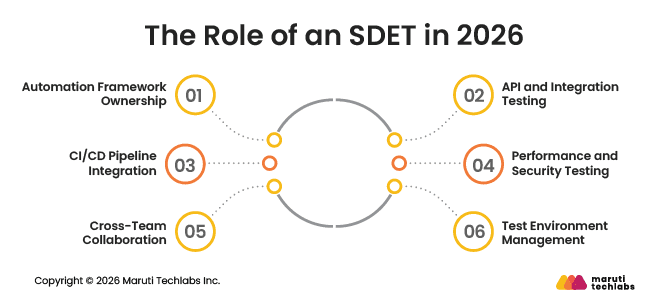
The Role of an SDET in 2026
The SDET role has evolved into a core engineering function focused on building and maintaining quality across the entire software lifecycle.
As software testing becomes more integrated with the software delivery pipeline, SDETs now handle a wide range of tasks:
1. Automation Framework Ownership
SDETs are responsible for designing and maintaining automation frameworks that support large-scale systems. These frameworks enable teams to write reusable, maintainable test cases and guarantee consistency across testing efforts.
2. API and Integration Testing
With the extensive adoption of microservices, SDETs focus heavily on validating service-to-service communication. They ensure APIs function correctly and that data flows seamlessly across distributed systems.
3. CI/CD Pipeline Integration
A key part of the role is embedding automated tests into CI/CD pipelines. This guarantees every code change is validated before deployment, reducing release risks and enabling continuous delivery.
4. Performance and Security Testing
SDETs simulate real-world conditions to evaluate system performance and discover vulnerabilities. This helps ensure applications can handle scale while remaining secure.
5. Cross-Team Collaboration
SDETs work closely with developers, DevOps engineers, and product teams to improve code testability, simplify workflows, and align testing with business goals.
6. Test Environment Management
They also manage test environments, monitor execution results, debug failures, and maintain test data to ensure reliable and consistent testing processes.
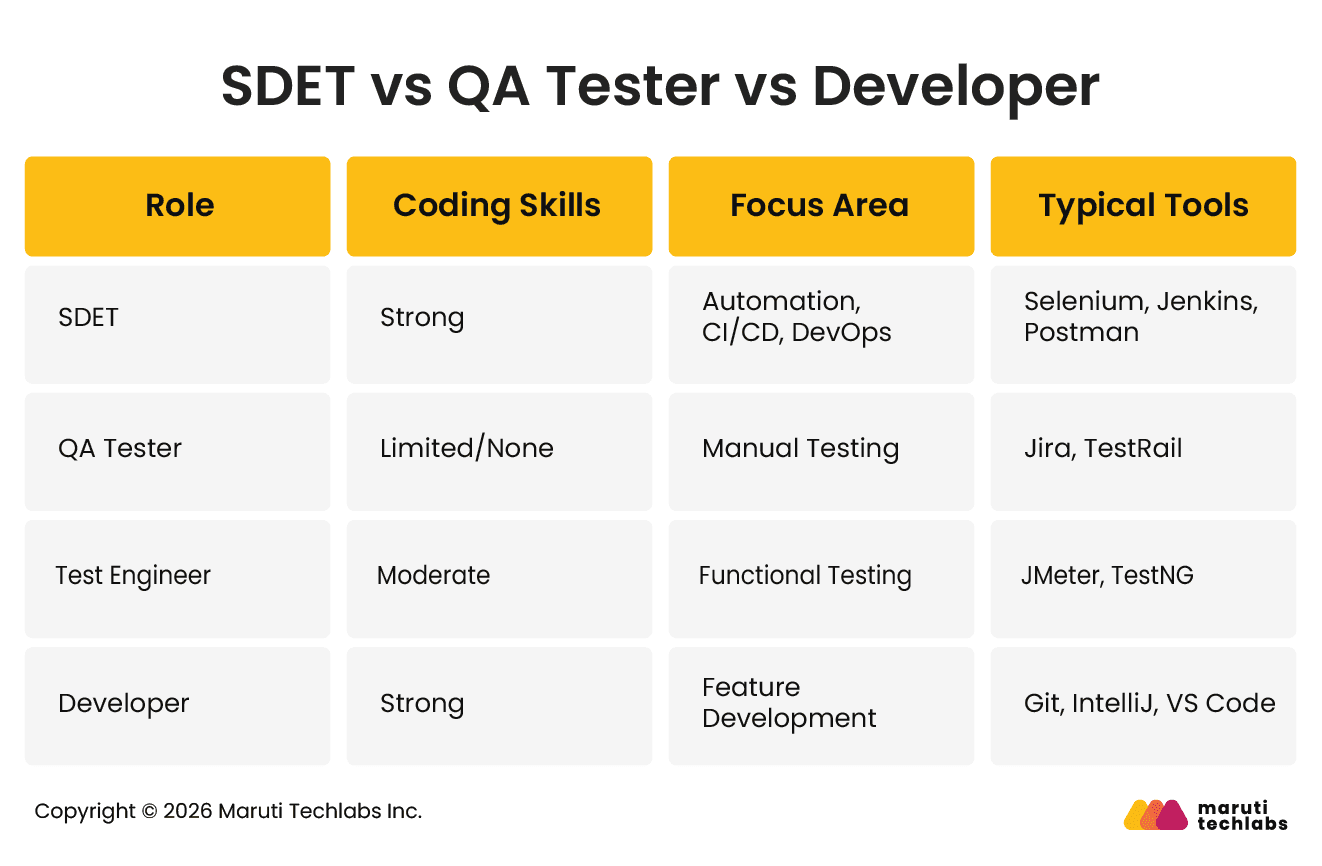
SDET vs QA Tester vs Developer
SDET focuses on building automation frameworks and assuring quality at scale through code, while QA testers primarily validate functionality through manual or limited automated testing, and developers build application features.
This comparison table highlights how SDETs bridge the gap between development and testing.
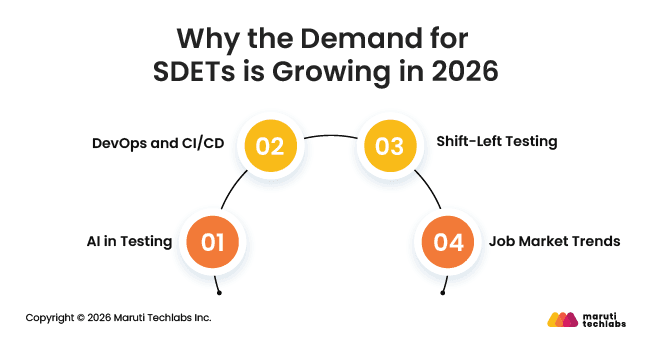
Why the Demand for SDETs is Growing in 2026
The demand for SDETs is growing in 2026 as the role shifts from manual testing to building AI-driven, automation-first quality systems. With faster code generation, SDETs need to design scalable, self-healing test frameworks aimed at ensuring reliable software delivery.
1. AI in Testing
AI-powered testing has moved from experimentation to mainstream adoption. Modern platforms such as Testim, Mabl, and Applitools use machine learning to self-heal test scripts, identify UI changes, and reduce flaky tests.
SDETs are now expected to work with these tools, fine-tune models, and integrate AI-driven insights into test strategies rather than relying only on static automation frameworks.
2. DevOps and CI/CD
The extensive adoption of DevOps has made continuous testing a non-negotiable part of delivery pipelines. SDETs play a key role in embedding automated tests into CI/CD workflows using tools such as Jenkins, GitHub Actions, and GitLab CI/CD.
This approach aligns with modern DevOps and CI/CD practices, where automated testing is deeply integrated into every stage of delivery.
3. Shift-Left Testing
Shift-left testing is no longer just a best practice; it is a necessity for reducing defect leakage and rework costs, especially when aligned with shift-left security implementation strategies. SDETs collaborate closely with developers during early development stages to design testable architectures, create unit and integration tests, and automate validation before code reaches production.
4. Job Market Trends
Demand for SDETs continues to rise across industries, including tech, healthcare, and finance, where software quality directly affects business outcomes. Sites like LinkedIn and Indeed consistently show thousands of open roles. Companies are emphasizing candidates who can code, automate, and integrate testing seamlessly into development workflows.
How AI is Impacting the Role of SDET in 2026
AI is reshaping the SDET role from manual automation to intelligent, system-driven testing. Tools like Testim, Mabl, and Applitools now enable self-healing tests, automatic test generation, and faster defect detection.
SDETs are no longer just writing scripts. They are designing AI-driven test frameworks, prioritizing test execution using predictive insights, and integrating intelligent testing into CI/CD pipelines through tools like Jenkins and GitHub Actions.
AI in software testing also raises skill expectations. SDETs need stronger programming fundamentals, familiarity with AI-powered tools, and the ability to analyze test data and model outputs.
In 2026, the role is evolving toward quality engineering at scale, where the focus is not just on catching defects, but on preventing them through smarter, data-driven testing systems.
SDET Career Path and Growth Opportunities
The SDET career path has become a clear and structured journey with strong growth opportunities. It combines software development skills with testing expertise. At each stage, SDETs improve their coding ability and gain a better understanding of how systems work.
Junior SDET
At the entry level, the focus is on establishing a solid foundation in programming and test automation. Junior SDETs typically work with frameworks such as Selenium or Cypress to write basic automated test cases, run regression suites, and understand application workflows. This stage is heavily learning-driven, with exposure to version control, debugging, and test design principles.
Mid-Level SDET
Mid-level SDETs move beyond execution into ownership. They design and maintain scalable test frameworks, improve test coverage, and integrate automation into CI/CD pipelines using tools such as Jenkins and GitHub Actions. They also work closely with developers to ensure testability and start contributing to performance and API testing strategies.
Senior SDET
At the senior level, the role shifts toward architecture and leadership. Senior SDETs define automation strategies, select tools, and build reusable testing infrastructure. They mentor junior engineers, enforce quality standards, and often work on complex areas like distributed systems testing, performance optimization, and test data management. Their decisions directly influence release quality and engineering velocity.
Automation Architect/QA Lead
In this role, professionals operate at an organizational level. They design end-to-end testing strategies across multiple teams, standardize tools and frameworks, and secure alignment with business and engineering goals. Automation Architects evaluate emerging technologies, including AI-powered testing platforms, and drive adoption to increase efficiency and scalability throughout projects.
QA Manager / Director of Engineering
At the leadership level, the focus expands to people, process, and strategy. These roles involve managing cross-functional teams, defining quality KPIs, overseeing delivery pipelines, and aligning testing practices with business outcomes. Leaders at this stage influence organizational culture by embedding quality into every phase of development.
1. Amazon – Software Development Engineer in Test (SDET)
At Amazon , the SDET role is designed as a hybrid engineering position that combines software development with advanced testing responsibilities. A typical example is the SDET II role within teams like Appstore or Kindle, where engineers work on large-scale, customer-facing systems.
Skills: Java, Selenium, REST API automation, CI/CD
Responsibilities:
Design and build scalable automated test frameworks and end-to-end test suites
Develop tools that help developers and QA teams improve testing efficiency
Collaborate with developers to review designs and identify automation opportunities
Participate in code reviews and system design discussions
Create test plans that simulate real-world user scenarios and ensure product reliability
What stands out:
Amazon SDETs often write production-level code and may even write more code than developers in some cases, as their work focuses on building systems that automatically validate product quality at scale.
2. Google – Software Engineer in Test (SET / SDET equivalent)
At Google, the SDET role is often represented as a Test Engineer (TE) or part of the Engineering Productivity (EngProd) team. These roles focus on improving software quality at scale by building tools, infrastructure, and systems that boost engineering efficiency.
Skills: C++/Java/Python, test automation, distributed systems, tooling, data analysis, CI/CD
Responsibilities:
Design and develop tools, frameworks, and infrastructure to improve testing and debugging operations
Examine complex systems to identify failure points, edge cases, and quality gaps
Automate repetitive testing tasks and optimize engineering workflows
Work closely with software engineers to improve system reliability and scalability
Use metrics and data-based insights to boost product quality and engineering velocity
What stands out:
Google’s SDET-equivalent roles focus less on writing test scripts and more on building systems that improve how software is developed, tested, and released across the organization.
3. Microsoft – Software Engineer in Test
At Microsoft, the Software Engineer in Test role is deeply integrated into cloud and distributed systems engineering. A typical example is an SDET working within the Azure Storage team, where engineers focus on testing and validating hyperscale cloud infrastructure.
Skills: C/C++/C#/Java/Python, automation frameworks, performance testing, cloud (Azure), distributed systems
Responsibilities:
Design, develop, and maintain automation frameworks, tools, and end-to-end test suites
Create and execute functional, integration, performance, and stress tests for large scale systems
Analyze system bottlenecks, latency problems, and resource deployment across compute and storage layers
Build tools to simplify test execution, reporting, and debugging
Collaborate with engineering teams to identify defects, perform root-cause analysis, and boost system reliability
What stands out:
Microsoft SDETs work on highly scalable cloud systems like Azure, focusing not just on testing features but also on validating performance, reliability, and system scalability at massive data scales (exabytes to zettabytes).
Conclusion
The SDET role in 2026 has moved far beyond traditional testing. It now sits at the core of modern software engineering, where speed, scale, and reliability must coexist. As automation becomes the foundation of CI/CD pipelines and AI continues to reshape testing practices, SDETs are no longer optional; they are essential.
From building robust automation frameworks to integrating intelligent testing into development workflows, SDETs ensure that quality is built into every stage of the lifecycle. Their ability to combine coding, testing, and system thinking makes them one of the most valuable roles in today’s tech domain.
For professionals, this presents a strong career path with high demand, competitive salaries, and continuous growth opportunities. For businesses, investing in SDET capabilities directly translates into faster releases, fewer defects, and more resilient systems.
As software complexity continues to grow, the role of SDETs will only become more strategic, determining how organizations build, test, and deliver top-quality applications at scale.
Why Maruti Techlabs for SDET and Automation Testing
Maruti Techlabs enables enterprises to build and scale automation-first quality engineering systems by combining deep SDET expertise with modern testing frameworks and CI/CD integration.
The team specializes in designing custom automation frameworks, integrating continuous testing into development pipelines, and enabling high test coverage across complex, distributed systems. This helps businesses improve software quality, reduce manual effort, and accelerate release cycles without compromising reliability.
We have helped enterprises implement scalable test automation frameworks designed for microservices-based architectures, achieving:
Faster regression cycles by automating 600+ UI and 1600+ microservices test cases Significant reduction in manual testing effort, saving 60+ hours per sprint Continuous testing through daily automated execution and CI/CD integration Improved defect detection with early feedback loops and detailed analysis Enhanced system reliability across distributed environments
To build and scale your automation strategy, explore our DevOps Consulting Services for streamlined CI/CD integration and continuous testing.
FAQs
1. What does an SDET do in 2026?
An SDET designs and develops automated testing frameworks, writes test scripts, and integrates testing into CI/CD pipelines. They ensure software quality throughout the development lifecycle by working closely with developers and DevOps teams, focusing on system scalability, speed, and reliability.
2. Is SDET a good career in 2026?
Yes, SDET is one of the most in-demand roles because of the growth of automation, DevOps, and AI-powered testing. It offers strong career growth, high salaries, and opportunities to transition into architecture or engineering leadership roles.
3. What skills are required to become an SDET?
SDETs need programming skills in languages like Java or Python, experience with automation tools such as Selenium or Playwright, knowledge of APIs, CI/CD pipelines, cloud platforms, and strong problem-solving skills.
4. What is the difference between an SDET and a QA tester?
SDETs focus on automation and write code to test applications, while QA testers primarily perform manual testing. SDETs are closely integrated into development workflows and contribute to engineering processes
5. Do SDETs need to know coding?
Yes, coding is essential for SDETs. They write automation scripts, build frameworks, and sometimes contribute to production code to improve testability and system quality.
6. What tools do SDETs use?
SDETs commonly employ tools like Selenium, Playwright, and Cypress for automation, Postman for API testing, Jenkins for CI/CD, and cloud platforms such as AWS or Azure for scalable testing environments.
7. What is the salary of an SDET in India in 2026
SDET salaries in India range from ₹6 LPA for entry positions to ₹35+ LPA for experienced professionals. Salaries depend on skills in automation, cloud technologies, and DevOps practices.
8. Can a manual tester become an SDET
Yes, manual testers can transition into SDET roles by learning programming, automation tools, and CI/CD practices. With consistent upskilling, the transition is highly achievable within 6 to 12 months.
9. What is shift-left testing in SDET
Shift-left testing involves starting testing early in the development process. SDETs implement this by integrating automated tests during development stages, reducing bugs and elevating overall software quality.
10. What industries hire SDETs
SDETs are in demand across industries such as fintech, healthcare, e-commerce, SaaS, and enterprise software, where continuous delivery and high-quality software are critical.
Himanshu Kansara oversees quality engineering and operational processes across the organisation. With over a 22+ of experience in software quality assurance, he has worked across desktop, mobile web, Android, and iOS platforms, managing both small and large-scale end-to-end testing programs. His experience spans waterfall, V-Model, iterative, and Agile testing environments, with a strong focus on onsite-offshore delivery models.
Stuck with a Tech Hurdle?
We fix, build, and optimize. The first consultation is on us!