Upskilling vs. Outsourcing: Making the Best Choice for Your Workforce
Discover the benefits and challenges of upskilling and outsourcing to bridge IT skill gaps and drive business growth.
Business Strategy
Upskilling vs. Outsourcing: Making the Best Choice for Your Workforce
Discover the benefits and challenges of upskilling and outsourcing to bridge IT skill gaps and drive business growth.
Table of contents
Table of contents
Introduction
The Growing Tech Talent Shortage
Upskilling: Investing in Your Existing Workforce
4 Benefits of Upskilling IT Talent
Outsourcing: Leveraging External Talent
4 Benefits of Outsourcing IT Talent
Key Comparison: Hiring Vs. Upskilling Vs. Outsourcing
Upskilling vs. Outsourcing: Which Is Best for Your Business?
Hybrid Approach: When to Combine Upskilling and Outsourcing?
Upskilling & Outsourcing: Challenges and Risk Mitigation
Conclusion
Introduction
The global IT talent shortage is a growing challenge for businesses. Factors like digital transformation, the pandemic, and shifting workforce trends have made finding and keeping skilled IT professionals harder. As companies struggle with unfilled roles, productivity gaps, and rising competition, they must decide how to bridge their skill shortages.
Two common ways to solve the tech talent shortage are upskilling employees and outsourcing IT work. Upskilling helps businesses improve skills within their team, keep employees happy, and encourage new ideas. Outsourcing allows companies to access experts and reduce the workload on their staff quickly.
In this blog, we’ll explore the IT talent shortage, the benefits and challenges of upskilling and outsourcing, and key factors to consider when choosing the right approach for your business. Understanding these options will help you make a strategic decision that aligns with your company’s goals and workforce needs.
The Growing Tech Talent Shortage
The demand for tech professionals has never been higher. Companies rapidly adopt new technologies, but there aren’t enough skilled workers to fill open roles. This talent gap has become a significant challenge, affecting businesses of all sizes.
A Gartner survey found that 64% of companies see the tech talent shortage as a big obstacle to adopting new technologies. Another survey by Indeed revealed that 83% of hiring managers believe the shortage is hurting their business, and 86% struggle to find top tech talent.
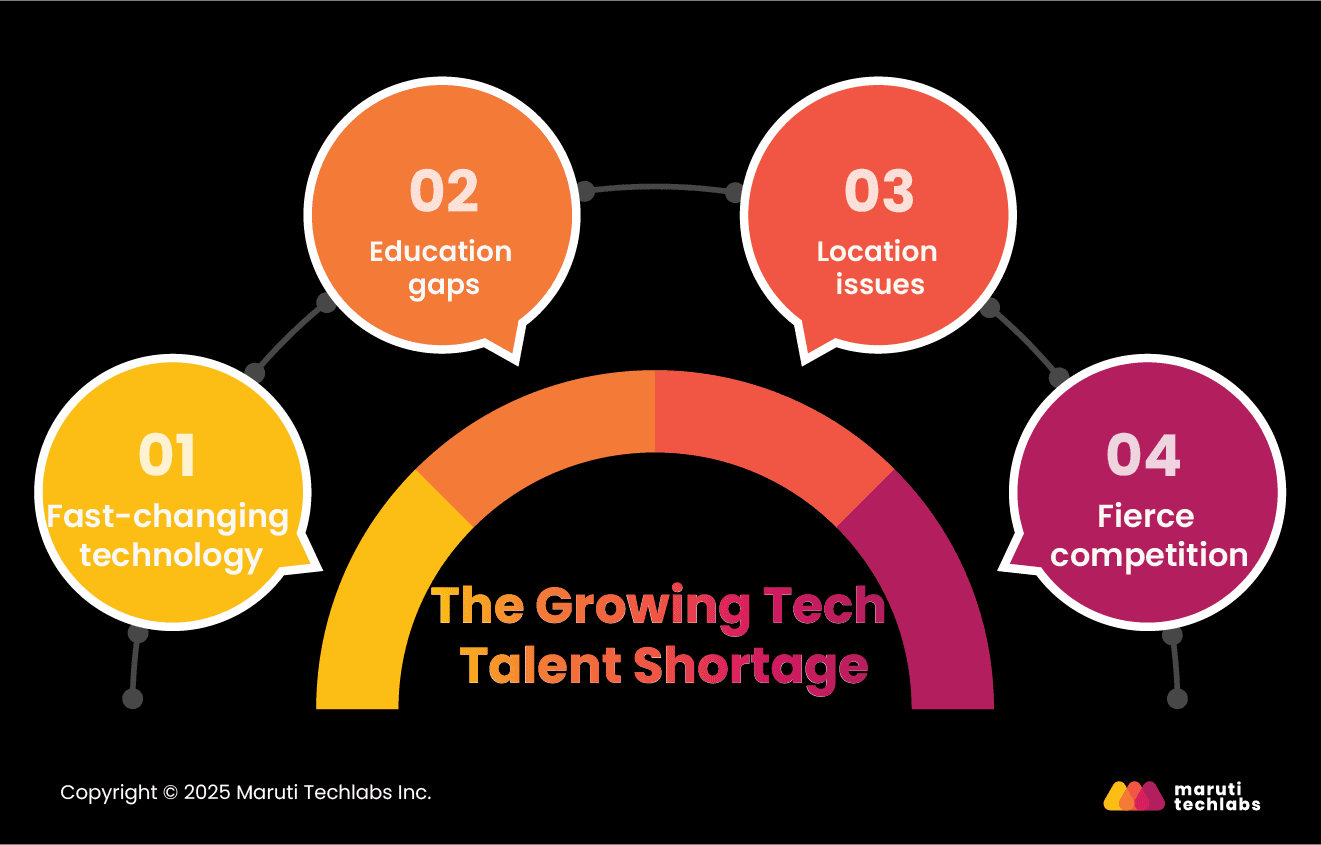
Several key factors that have contributed to this shortage are:
Fast-changing technology – AI, cloud computing, and blockchain are evolving quickly, making it hard for training programs to keep up.
Education gaps – Traditional degrees don’t always teach the hands-on skills needed in the workplace.
Location issues – Tech talent is concentrated in major hubs, leaving many regions with limited options.
Fierce competition – Big companies offer high salaries and perks, making it challenging for smaller businesses to attract skilled workers.
Because of these, companies face higher hiring costs, slower innovation, employee burnout, and reduced productivity due to unfilled positions. In the long run, the shortage could hurt industries and economies worldwide.
To solve this, businesses are investing in education, upskilling employees, offering remote work, and improving diversity in hiring. The right approach can help companies bridge the gap and stay competitive in the evolving tech landscape.
Upskilling: Investing in Your Existing Workforce
Upskilling is the process of training current employees to develop new skills. Businesses can strengthen their teams instead of hiring new talent by equipping employees with the knowledge they need to take on evolving roles. This approach not only helps companies address skill gaps but also boosts employee engagement and loyalty.
Pros of Upskilling
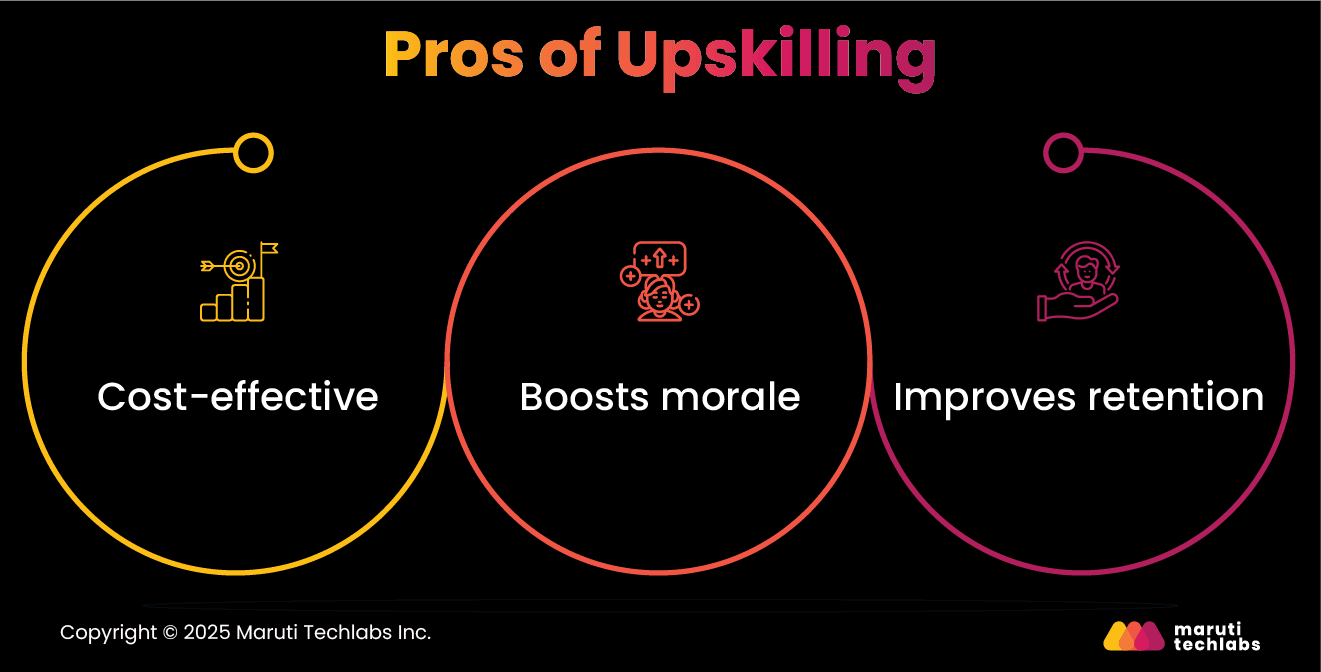
Here are the main pros of upskilling:
Cost-effective – Recruiting and onboarding new employees comes at a high cost. Upskilling is often a more affordable way to build in-house expertise.
Boosts morale – Employees feel valued when their company invests in their growth, leading to higher job satisfaction.
Improves retention – Workers are more likely to stay when they see learning and career advancement opportunities. In fact, 93% of millennials and Gen-Z employees expect on-the-job training.
Cons of Upskilling
Some of the cons of upskilling are:
Takes time – Training employees isn’t an instant fix. If a company needs skills immediately, upskilling may not be the best option.
Limited by current staff – Not every employee can easily transition into a new role. Existing skills and learning capacity may limit how much upskilling can be achieved.
While upskilling is a valuable investment, it works best as a long-term strategy rather than a quick solution. Companies must assess their needs, timelines, and workforce potential before committing to this approach.
4 Benefits of Upskilling IT Talent
Upskilling IT talent strengthens internal capabilities and prepares organizations for evolving technology demands. It transforms existing teams into strategic contributors who can support innovation, operational stability, and long term business growth.
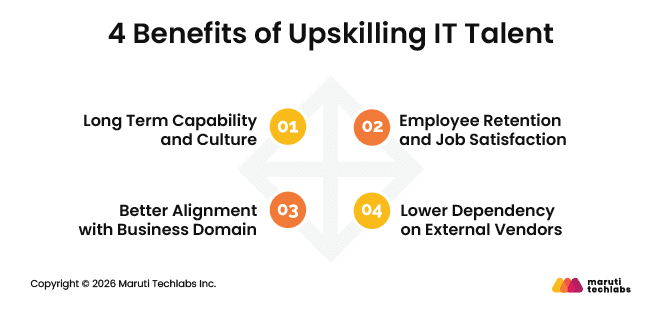
1. Long-Term Capability and Culture
Investing in skill development builds institutional knowledge that compounds over time. Teams gain a deeper understanding of systems, architecture, and business processes.
This continuity fosters ownership, accountability, and a learning culture where improvement becomes part of daily operations rather than a reactive response to change.
2. Employee Retention and Job Satisfaction
Providing structured learning opportunities signals commitment to employee growth. Professionals who see a clear development path are more engaged and motivated.
Upskilling reduces attrition by aligning career progression with organizational goals, lowering replacement costs while strengthening morale, loyalty, and overall team performance across projects.
3. Better Alignment with Business Domain
Internal teams understand company products, customers, and workflows better than external partners. When technical skills improve within that context, solutions become more relevant and efficient.
Upskilled employees can translate business objectives into technical execution more accurately, reducing miscommunication and improving delivery consistency.
4. Lower Dependency on External Vendors
Building in-house expertise reduces reliance on outside consultants for critical functions. Organizations gain greater control over priorities, timelines, and intellectual property.
Over time, this reduces recurring vendor costs and mitigates risks associated with knowledge gaps, contractual limitations, or constraints on external resource availability.
Outsourcing: Leveraging External Talent
Outsourcing involves hiring external experts or agencies to handle specific tasks or projects. Instead of training in-house employees, companies can contract specialists to quickly fill skill gaps. This approach is often used for roles that require niche expertise or short-term support. While outsourcing offers flexibility and speed, it also comes with challenges that businesses must consider.
Pros of Outsourcing
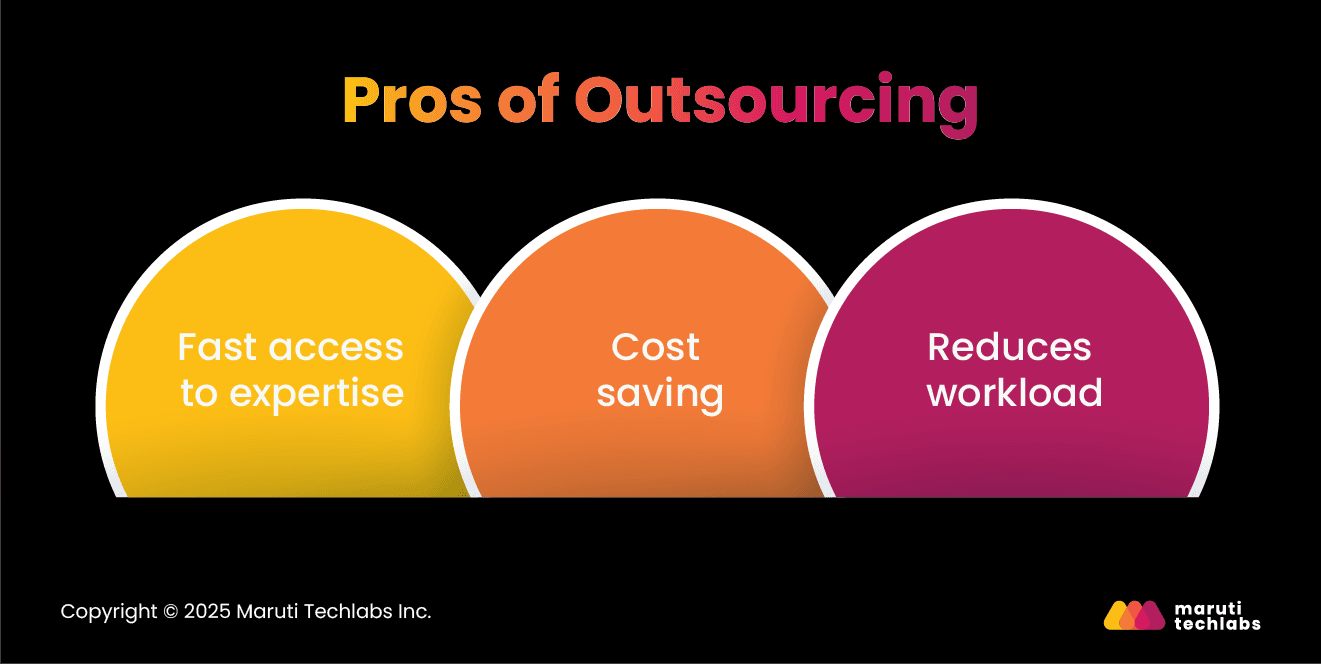
Here are the main pros of outsourcing:
Fast access to expertise – Companies can quickly bring in skilled professionals without the time and effort needed for training.
Cost savings – Outsourcing is often more cost-effective than a full-time hire for short projects or specialized tasks.
Reduces workload – Outsourcing frees up internal teams to focus on core business priorities.
Cons of Outsourcing
Some of the cons of outsourcing are:
Quality control issues – Relying on external providers means less control over work quality, which can lead to inconsistencies.
Limited oversight – Companies may have less influence over outsourced tasks, making it harder to ensure alignment with business goals.
Potential security risks – Sharing data and intellectual property with external vendors can pose security and confidentiality challenges.
Outsourcing can be a great way to bridge skill gaps, but choosing the right partners and having clear agreements is important. For businesses weighing their options, balancing outsourcing with in-house expertise can help create a more flexible and sustainable workforce strategy.
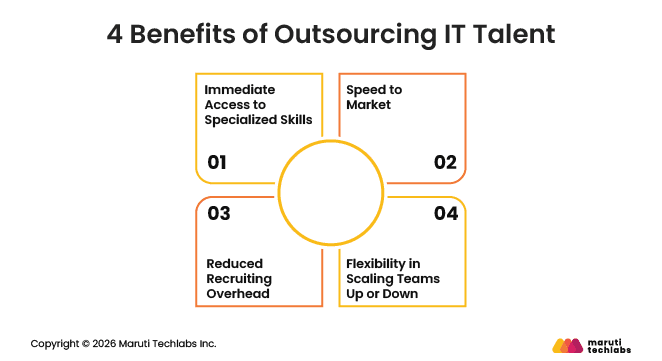
4 Benefits of Outsourcing IT Talent
Outsourcing IT talent enables organizations to access expertise quickly without long hiring cycles. It supports rapid execution, specialized delivery, and flexible capacity management in fast-changing technology environments.
1. Immediate Access to Specialized Skills
External partners often bring niche capabilities in emerging technologies, cybersecurity, cloud architecture, or advanced analytics. This expertise may be difficult or expensive to build internally.
Outsourcing provides direct access to experienced professionals who have solved similar challenges across industries and can contribute immediately.
2. Speed to Market
With established processes and trained teams, outsourcing partners can accelerate project timelines. Organizations avoid lengthy recruitment and onboarding cycles, enabling faster product launches or digital transformations.
This improved execution speed can create a competitive advantage and earlier revenue realization in dynamic markets.
3. Reduced Recruiting Overhead
Hiring skilled technology professionals requires sourcing, screening, interviewing, onboarding, and retention management. Outsourcing shifts much of this operational burden to the partner organization.
This reduces administrative costs, internal management effort, and uncertainty associated with talent acquisition in competitive labor markets.
3. Flexibility in Scaling Teams Up or Down
Project demands often fluctuate based on funding cycles or market conditions. Outsourcing provides elasticity, allowing organizations to increase or reduce team size without long term employment commitments.
This flexibility improves cost efficiency and resource allocation while maintaining operational agility.
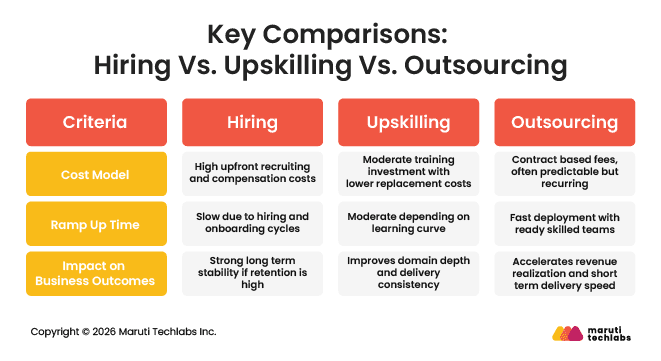
Key Comparison: Hiring Vs. Upskilling Vs. Outsourcing
Upskilling vs. Outsourcing: Which Is Best for Your Business?
When facing an IT talent shortage, businesses often struggle to decide between upskilling their current workforce or outsourcing to external experts. There’s no one-size-fits-all answer—some skills are better suited for internal training, while others may require immediate external support. The right approach depends on project urgency, budget, and long-term business goals.
How to Decide the Best Approach
To make the best decision, businesses should:
Evaluate their workforce – Identify existing skills and determine if employees have the potential to be trained for new roles.
Pinpoint skill gaps – Understand what’s missing and whether those gaps need to be filled quickly or can be addressed over time.
Consider budget and urgency – Upskilling takes time but is cost-effective in the long run. Outsourcing provides instant access to expertise but may be more expensive for ongoing needs.
Prioritize critical skills – Some roles are essential for business growth, innovation, and long-term success. These are worth developing in-house, while less strategic or temporary tasks may be better outsourced.
Upskilling is an excellent investment for businesses that need to maintain knowledge continuity and foster internal growth. However, outsourcing can provide an immediate solution for highly specialized skills or urgent projects.
The Hybrid Approach: Finding the Right Balance
Many companies find that a combination of upskilling and outsourcing works best. A hybrid approach allows businesses to:
Develop internal talent – Investing in training programs creates a workforce that can adapt to new technologies and reduces reliance on external resources.
Outsource non-core tasks – Specialized or short-term projects can be outsourced, allowing internal teams to focus on strategic goals.
Balancing upskilling and outsourcing helps businesses work smarter, save money, and build a strong team for the future. The key is to stay flexible and adjust as needs change.
Hybrid Approach: When to Combine Upskilling and Outsourcing?
A hybrid approach balances immediate execution needs with sustainable capability building. Organizations can engage external specialists to deliver complex or time sensitive initiatives while simultaneously training internal teams through collaboration and knowledge transfer.
This model ensures critical projects move forward without delay, while internal staff gradually develop the expertise required to maintain and extend those systems. Over time, reliance on external partners decreases as internal capability matures.
The hybrid structure also reduces operational risk, since external experts provide oversight during transition phases while internal teams gain confidence and technical depth.
For Example, an organization may outsource cloud migration architecture to experienced consultants while training internal engineers on cloud operations and governance. Once the migration stabilizes, internal teams assume ongoing management, reducing long-term dependency while preserving strategic knowledge.
Upskilling & Outsourcing: Challenges and Risk Mitigation
Both upskilling and outsourcing present operational and strategic challenges. Understanding these risks in advance allows organizations to implement mitigation strategies that protect timelines, budgets, and long-term objectives.
1. Upskilling: Challenges and Mitigation
Training requires time, budget, and temporary productivity tradeoffs. Employees may struggle to balance learning with project deadlines.
Organizations can address this by defining structured learning paths, allocating protected training time, setting measurable milestones, and aligning skill development directly with upcoming business initiatives.
2. Outsourcing: Challenges and Mitigation
Outsourcing may create communication gaps, reduced visibility, or dependency risks. Differences in culture or expectations can affect outcomes.
Clear service agreements, regular performance reviews, transparent reporting, and defined knowledge transfer plans help maintain accountability and protect long term organizational interests.
Real World Use Cases
Different organizational contexts influence whether upskilling, outsourcing, or hybrid models deliver better results.
1. Startups
A startup with limited capital and urgent product deadlines may rely heavily on outsourcing to accelerate development. As the company stabilizes revenue streams, it can gradually invest in building internal teams to retain knowledge and reduce long term external dependency.
2. Mid-Sized Firms
A mid-sized technology company expanding into new markets might upskill its existing workforce in advanced analytics while outsourcing short-term implementation support. This ensures rapid delivery while strengthening internal expertise aligned with future strategic growth initiatives.
3. Enterprises
Large enterprises often combine both approaches. They may outsource specialized modernization efforts while running enterprise-wide training programs to improve digital literacy. This balanced strategy supports transformation at scale while preserving institutional knowledge and ensuring operational continuity.
Conclusion
There’s no one-size-fits-all solution to the tech talent shortage. Upskilling, outsourcing, and hiring each come with pros and cons. Upskilling fosters a skilled, loyal workforce but requires time. Outsourcing offers fast expertise but may raise quality or control issues. Hiring fills skill gaps but can be costly and time-intensive.
A balanced approach is often the best solution. Investing in upskilling ensures long-term growth, while outsourcing can help fill immediate needs. By combining both strategies, businesses can stay efficient, competitive, and ready for the future.
Is outsourcing a part of your business strategy? Contact Maruti Techlabs for IT outsourcing services to bolster your business growth.
Mitul Makadia is the Founder and CEO of Maruti Techlabs, a custom software and AI engineering company he built from the ground up in 2009. Over 20+ years, he has led product development, business strategy, and engineering teams across startups to Fortune 500 clients.
Stuck with a Tech Hurdle?
We fix, build, and optimize. The first consultation is on us!