Top 10 RPA Use Cases In Telecommunications - Automation in Telecom
Check how RPA can fit the ever increasing demand for seamless connectivity and customized solutions.
Robotic Process Automation
Top 10 RPA Use Cases In Telecommunications - Automation in Telecom
Check how RPA can fit the ever increasing demand for seamless connectivity and customized solutions.
Table of contents
Table of contents
Key Takeaways
Introduction
What is RPA in Telecom?
Why RPA in Telecom Industry is Worth Investing?
Key Challenges Driving RPA Adoption
Benefits of RPA in Telecom
Top 10 RPA Use Cases in Telecom
5 Steps To Implement RPA in Telecommunications
Conclusion
Why Maruti Techlabs for RPA in Telecom
FAQs
Key Takeaways
RPA helps telecom companies automate repetitive, rule-based processes across operations
It reduces operational costs by 20–30% and improves process efficiency significantly
Telecom use cases include billing, onboarding, network management, and SIM provisioning
Companies achieve faster execution, improved accuracy, and better customer satisfaction
ROI from RPA implementation is typically achieved within 6–9 months
Combining RPA with AI enables intelligent automation for future-ready telecom operations
A structured implementation approach ensures successful scaling across enterprise workflows
Introduction
The telecommunications industry operates at a massive scale, handling millions of customer interactions, transactions, and network events every single day. As digital consumption increases, telecom providers are under constant pressure to deliver faster services, reduce downtime, and personalize customer experiences, all while controlling operational costs.
At the same time, legacy systems, fragmented data environments, and manual workflows continue to slow down operations. This creates a gap between customer expectations and service delivery.
Robotic Process Automation (RPA) is emerging as a practical solution to bridge this gap. The RPA market is forecast to grow at a CAGR of over 41% between 2026 and 2030, driven by demand for efficiency and cost optimization.
By automating repetitive, rule-based processes, RPA helps telecom companies improve operational efficiency, reduce errors, and free up human resources for higher-value work. If you’re exploring broader transformation strategies, understanding how enterprise automation solutions, such as automation testing services, fit into telecom operations can provide a clearer roadmap for scaling automation.
What is RPA in Telecom?
RPA in telecom refers to the use of software bots to automate structured, repetitive tasks across telecom operations. These bots mimic human actions such as logging into systems, extracting data, validating inputs, and executing transactions across multiple applications.
Unlike traditional automation approaches that require deep system integration, RPA works at the user interface level. This makes it especially valuable in telecom environments where legacy systems are common and difficult to replace.
For example, an RPA bot can automatically process a customer’s service request by pulling data from CRM systems, updating billing platforms, and triggering provisioning workflows without manual intervention.
In essence, RPA acts as a digital workforce that operates 24/7, delivering consistent performance, faster execution, and near-zero errors.
Why RPA in Telecom Industry is Worth Investing?
Investing in Robotic Process Automation (RPA) in the telecom industry delivers significant value by addressing operational inefficiencies, reducing costs, and improving service quality. As telecom providers scale to meet rising customer demand and data volumes, automation becomes essential to streamline processes and maintain a competitive edge.
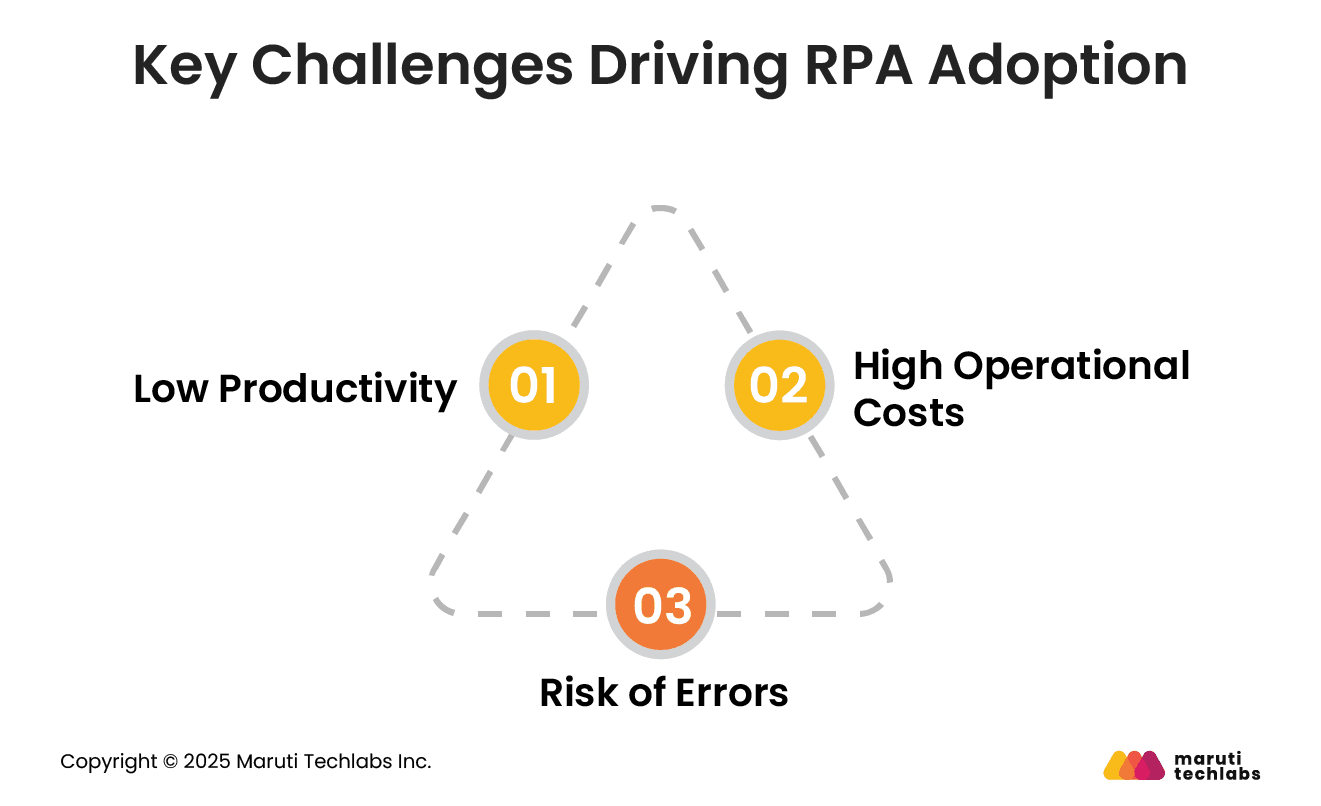
Key Challenges Driving RPA Adoption
1. Low Productivity
Telecom operations rely heavily on manual intervention across multiple systems, from customer management to network operations. Employees often spend a significant portion of their time switching between platforms, updating records, and validating data.
Organizations adopting automation technologies can achieve a 20–30% reduction in operational costs, reflecting significant efficiency gains in data-heavy processes.
2. High Operational Costs
Telecom providers face continuous pressure to maintain infrastructure, manage large workforces, and ensure compliance with regulatory requirements. Manual processes further increase these costs due to inefficiencies and rework.
Automation at scale can deliver up to 30% cost reduction over five years in process-intensive operations, making it a key lever for long-term operational savings.
3. Risk of Errors
Manual data handling in billing, provisioning, and customer service processes introduces a high risk of errors. Even minor inaccuracies can lead to billing disputes, service disruptions, and customer dissatisfaction.
Companies implementing automation in customer operations can achieve 15–25% improvement in customer satisfaction scores (CSAT) due to faster resolution times and reduced manual errors.
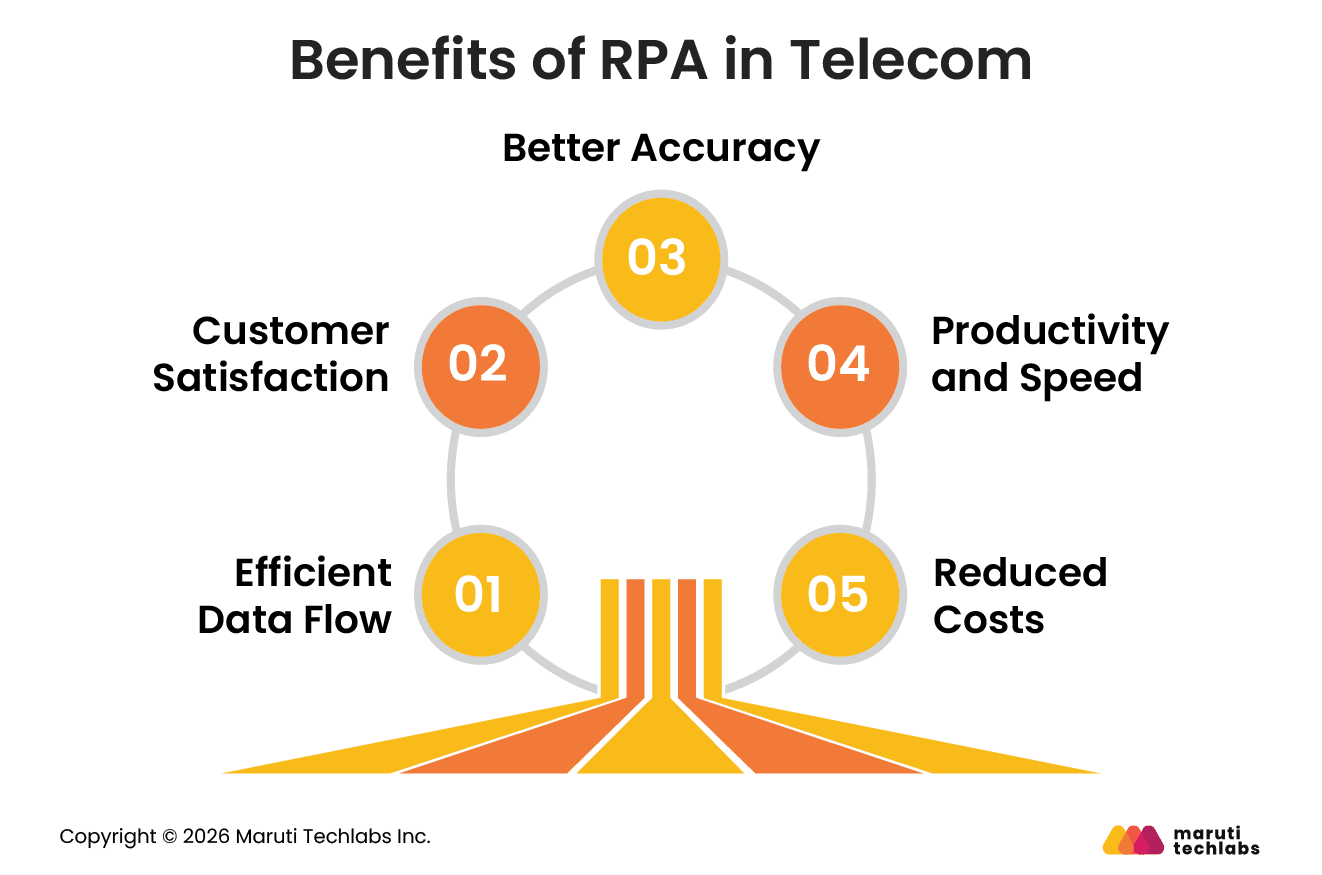
Benefits of RPA in Telecom
RPA benefits telecom providers by automating repetitive, rule-based tasks across systems, thereby enhancing efficiency and delivering faster, more reliable customer experiences.
1. Efficient Data Flow
Most telecom systems are isolated, posing challenges for securing a seamless data flow. This is where RPA comes into play by creating a seamless connection between systems through automated data transfers.
2. Customer Satisfaction
Through automation, RPA eliminates service delivery delays. Faster responses coupled with accurate information enhance customer experiences.
3. Better Accuracy
RPA is governed by set rules and procedures, following a pre-defined workflow. This leaves no scope for errors and near-perfect accuracy.
4. Productivity and Speed
Automation speeds up task execution by a great margin. Hours of work may take just minutes through RPA, thus ensuring a 60-80% increase in speed. Employees can focus on implementing their strategic goals rather than executing repetitive tasks.
5. Reduced Costs
By automating manual tasks, telecom companies can lower reliance on large operational teams and minimize rework due to errors.
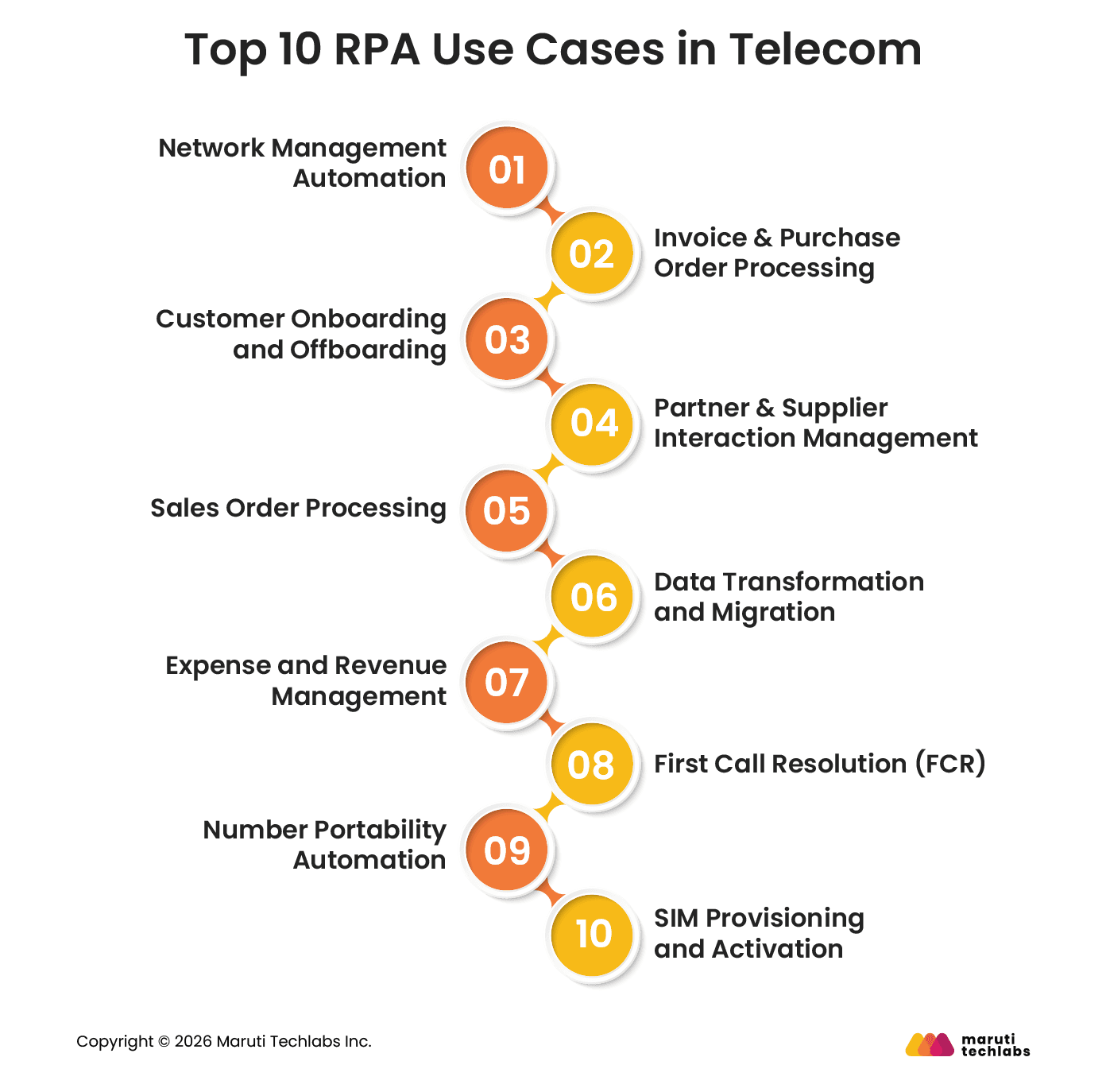
Top 10 RPA Use Cases in Telecom
RPA is transforming telecom operations by automating high-volume, rule-based processes across network management, customer service, finance, and provisioning. These use cases highlight how telecom providers can improve efficiency, reduce errors, and deliver faster, more reliable services at scale.
1. Network Management Automation
The management of complicated telecom networks requires constant monitoring and the solving of incidents. RPA will automatically monitor the network, gather data on its performance, and generate alerts in case of any irregularities.
Example: AT&T uses robotic process automation extensively; it has deployed more than 3,000 bots to manage operations related to service delivery and network provisioning. Some of the tasks automated by the bots include the addition of network circuits and service requests.
2. Invoice & Purchase Order Processing
RPA is responsible for performing automated activities in verifying, extracting, and reconciling the invoices. This decreases the effort of employees in the finance department and increases efficiency.
Example: Openreach, a subsidiary of the BT Group, reduced operational processing time from 20 minutes to just one minute through automation, highlighting how RPA can transform high-volume, repetitive workflows and enhance overall efficiency in back-office operations.
3. Customer Onboarding and Offboarding
The onboarding process includes several tasks such as identity verification, activation of the plan, and updating systems. RPA automates all the onboarding steps, making the process faster and more accurate.
Example: Telefónica Germany uses over 250 RPA bots to automate customer-related workflows such as data processing, document verification, and system updates, handling up to 90,000 cases daily.
4. Partner & Supplier Interaction Management
Telecommunications firms deal with partners, distributors, and resellers that often need information about orders, invoices, and other service requests. RPA robots automate these activities by collecting information from emails and system data, updating relevant files, and ensuring requests are forwarded to the appropriate departments.
Example: The United Kingdom's Premier Foods utilized RPA through UiPath to automate their activities with suppliers in the areas of financial accounting and supply chain management.
5. Sales Order Processing
Manual order fulfillment can lead to delays and is prone to errors. The automation of the sales order process, validation, and monitoring using RPA results in efficient and accurate processing of sales order requests.
Example:Siemens uses RPA to automate sales order processing by extracting order data, validating it against internal systems, and updating ERP platforms. This resulted in faster order fulfillment and improved accuracy.
6. Data Transformation and Migration
Telecom firms manage huge amounts of structured and unstructured data. RPA streamlines data format issues and enables easier data migration.
Example: Using RPA bots, Chorus automated its data migration process from legacy systems to newer systems for more efficient and accurate migrations. In particular, the organization used Blue Prism to carry out the task and achieved an average of 50,000 transactions monthly.
7. Expense and Revenue Management
RPA automates expense tracking, billing reconciliation, and revenue reporting. This improves financial visibility and ensures accurate revenue management.
Example:Telkomsel used RPA bots to automate its invoice management process, including invoice data extraction, validation, and upload to relevant financial platforms.
8. First Call Resolution (FCR)
RPA provides customer service agents with real-time access to relevant data, enabling faster issue resolution during the first interaction.
Example:Openreach automated its customer support workflows using RPA bots that capture requests, gather data from multiple systems, and trigger service actions, enabling faster issue resolution and reducing handling time from 20 minutes to about one minute.
9. Number Portability Automation
Mobile Number Portability (MNP) involves multiple verification and validation steps. RPA automates these workflows, reducing processing time from days to hours and improving customer experience.
Example: Australia’s largest telecommunications company, Telstra, leveraged robotic process automation with support from Wipro to streamline high-volume customer transition processes. While the case primarily focused on order entry and large-scale customer migrations, the same automation framework can be applied to number portability workflows.
10. SIM Provisioning and Activation
SIM activation requires coordination between multiple systems. RPA automates registration, verification, and activation processes, enabling faster service delivery. Example: Reliance Jio uses automation to efficiently manage large-scale SIM activations.
Example: Vodafone Idea’s Self-KYC solution enables fully digital SIM provisioning and activation. This allows customers to complete verification, order SIMs, and activate services remotely.
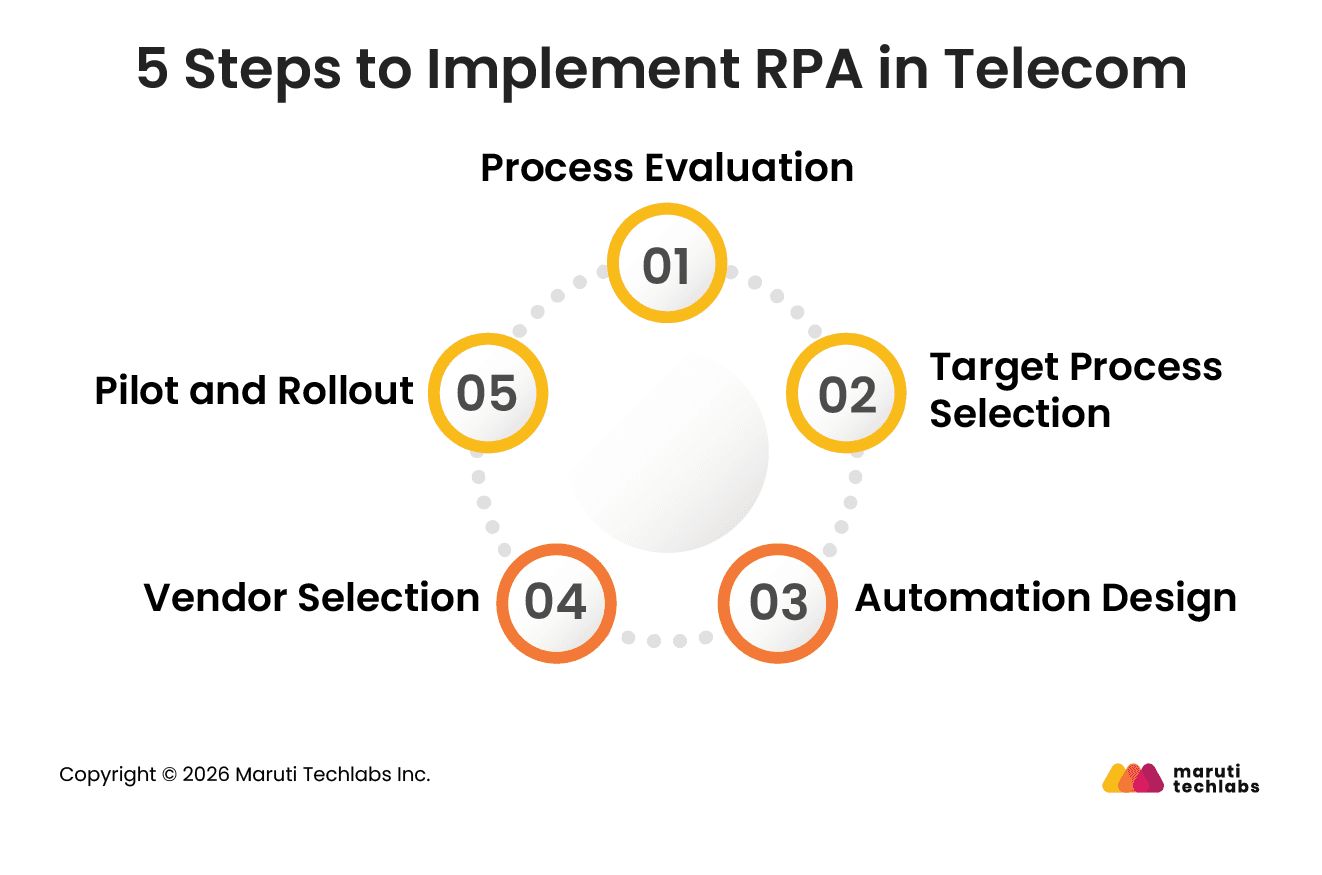
5 Steps To Implement RPA in Telecommunications
A structured approach to RPA implementation ensures faster adoption, minimal disruption, and measurable business outcomes. By following the right steps, telecom providers can identify high-impact opportunities, optimize processes, and scale automation effectively across operations.
1. Process Evaluation
Assess existing workflows to identify inefficiencies, redundancies, and automation opportunities. Focus on processes that are repetitive and rule-based.
2. Target Process Selection
Prioritize processes with high volume and measurable impact. These are typically the quickest to deliver ROI from RPA.
3. Automation Design
Redesign workflows to optimize them for automation. This includes eliminating unnecessary steps and standardizing inputs.
4. Vendor Selection
Choose an RPA partner with telecom expertise and a proven track record in handling complex automation projects.
5. Pilot and Rollout
Start with a pilot project to validate performance and scalability. Once successful, expand automation across other processes.
Conclusion
RPA is no longer a supplementary technology in telecom; it is becoming a foundational element for operational efficiency. By automating repetitive processes, telecom providers can reduce costs, improve accuracy, and enhance customer experiences.
As the industry continues to evolve, the combination of RPA and AI will play a crucial role in enabling intelligent, scalable, and future-ready telecom operations.
Why Maruti Techlabs for RPA in Telecom
Maruti Techlabs specializes in delivering scalable RPA solutions tailored for telecom enterprises. With deep expertise in automation and AI, we help organizations streamline operations and achieve measurable business outcomes.
We specialize in designing automation solutions that reduce manual effort, eliminate errors, and improve operational efficiency across complex telecom environments.
We helped a leading enterprise automate a high-volume, time-intensive operational workflow using a custom RPA solution.
1. What telecom processes are best suited for RPA?
Processes that are repetitive, rule-based, and high-volume are best suited for RPA. These include billing, onboarding, provisioning, and customer support workflows.
2. How long does RPA implementation take for a telecom company?
A pilot implementation typically takes 6–12 weeks, while enterprise-wide deployment can take several months depending on complexity.
3. What is the ROI of RPA in telecom?
Telecom companies often achieve ROI within 6–9 months, with cost reductions of 20–30% and significant efficiency improvements.
4. What is the difference between RPA and AI automation in telecom?
RPA automates structured, rule-based tasks, while AI enables decision-making and predictive insights. Together, they deliver intelligent automation.
5. Which RPA tools are most used in the telecom industry?
Commonly used tools include UiPath, Automation Anywhere, and Blue Prism, known for their scalability and enterprise capabilities.
Pinakin Ariwala has over 20 years of experience in AI/ML, data engineering, and software development. He has led AI and machine learning projects across industries, including agriculture, finance, and healthcare, and has been featured on the Clutch Leaders Matrix podcast discussing real-world AI/ML applications.
Stuck with a Tech Hurdle?
We fix, build, and optimize. The first consultation is on us!